Last updated: August 17, 2026
Sphera found that 73% of supply-chain leaders experienced supplier disruption within 12 months. A cheap quote cannot protect production from a failed supplier, blocked route, or invalid certificate. The six-step sourcing process forces procurement to test those risks before signing the award.
Executive summary: What should procurement leaders know?
TL;DR: The six-step sourcing process turns a business need into a controlled supplier relationship, then measures whether the promised value reaches operations.
- The six steps: Analyze spend, research the market, build the strategy, evaluate suppliers, negotiate the contract, and manage performance.
- The commercial rule: Compare Total Cost of Ownership (TCO), not unit price alone.
- The operating rule: Apply the Six Rs: right quality, quantity, time, source, price, and place.
- The risk signal: Supplier.io found 91% of leaders had adjusted, or planned to adjust, small-business sourcing because of tariffs.
- The self-check: Use the Sourcing Maturity Matrix to place your team at Reactive, Tactical, Strategic, or Intelligent.
Direct answer: The 6-step sourcing process is a repeatable procurement method covering spend and need analysis, market research, sourcing strategy, supplier evaluation, negotiation and contracting, and supplier implementation and performance management.
Why does the six-step sourcing process matter in 2026?
TL;DR: Procurement protects margin only when it joins price, demand, supplier evidence, implementation, and disruption risk in one decision.
Situation: Procurement once rewarded the lowest compliant quote.
Complication: Tariffs, sanctions, route disruption, supplier distress, and emissions requests now change cost after award. A saving on paper can become a shortage in production.
Question: How can a buyer reduce cost without buying hidden operational risk?
Answer: Use six controlled steps. Each step produces evidence for the next decision. Keep commercial authority with named people, even when software prepares the analysis.
Strategic sourcing is a repeatable way to select and manage supply against business requirements, total value, and risk. It replaces isolated price negotiations with category data, market evidence, cross-functional judgment, and supplier performance controls.
Use this six-step model for a clear operational overview. Use the advanced seven-step strategic sourcing guide when you need separate requirements, qualification, RFx, award, resilience scoring, and AI-governance gates.
What is the difference between purchasing, sourcing, and strategic sourcing?
TL;DR: Purchasing executes approved transactions, sourcing finds supply, and strategic sourcing manages a category for sustained total value.
| Criteria | Purchasing | Sourcing | Strategic sourcing |
|---|---|---|---|
| Core question | How do we transact? | Who can meet the need? | What supply model creates the best total value? |
| Focus | Orders, receipts, invoices, payment | Supplier discovery and selection | Category economics, risk, contracts, and performance |
| Time horizon | Short term | Event based | Continuous |
| Main metric | Accuracy and cycle time | Supplier fit and competition | TCO, continuity, quality, adoption, and improvement |
| Typical team | Procurement operations | Procurement and supply chain | Cross-functional business team |
| Failure mode | Slow or inaccurate transaction | Weak shortlist | Attractive award that fails in operations |
Sourcing usually ends with a supplier decision. Purchasing turns that decision into orders and payments. Strategic sourcing continues through implementation, performance reviews, improvement, and re-sourcing.
What are the six steps in the sourcing process?
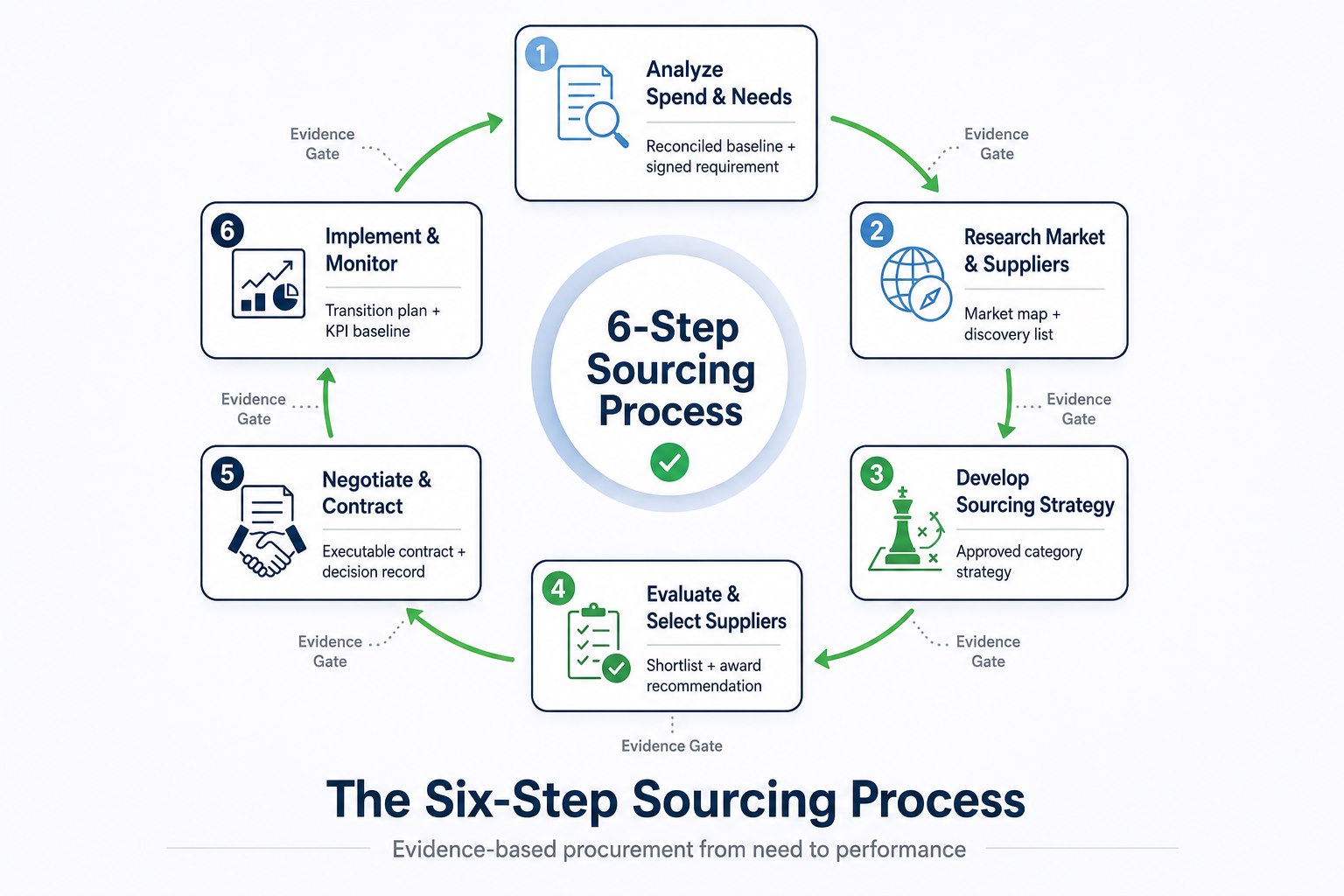
TL;DR: The process moves from a reconciled need to market evidence, a sourcing route, supplier selection, a complete contract, and measured operational value.
| Step | Decision question | Required output |
|---|---|---|
| 1. Analyze spend and needs | What are we buying, why, and under which constraints? | Reconciled baseline and signed requirement |
| 2. Research market and suppliers | What supply options and risks exist? | Market map and discovery list |
| 3. Develop the sourcing strategy | Which route, lot, geography, and fallback fit? | Approved category strategy |
| 4. Evaluate and select suppliers | Which bidders pass the gates and create value? | Evidence-backed shortlist and award recommendation |
| 5. Negotiate and contract | Which complete deal should the company sign? | Executable contract and decision record |
| 6. Implement and monitor | Did the award deliver operational value? | Transition plan, KPI baseline, and action triggers |
Step 1: Analyze spend and identify the need
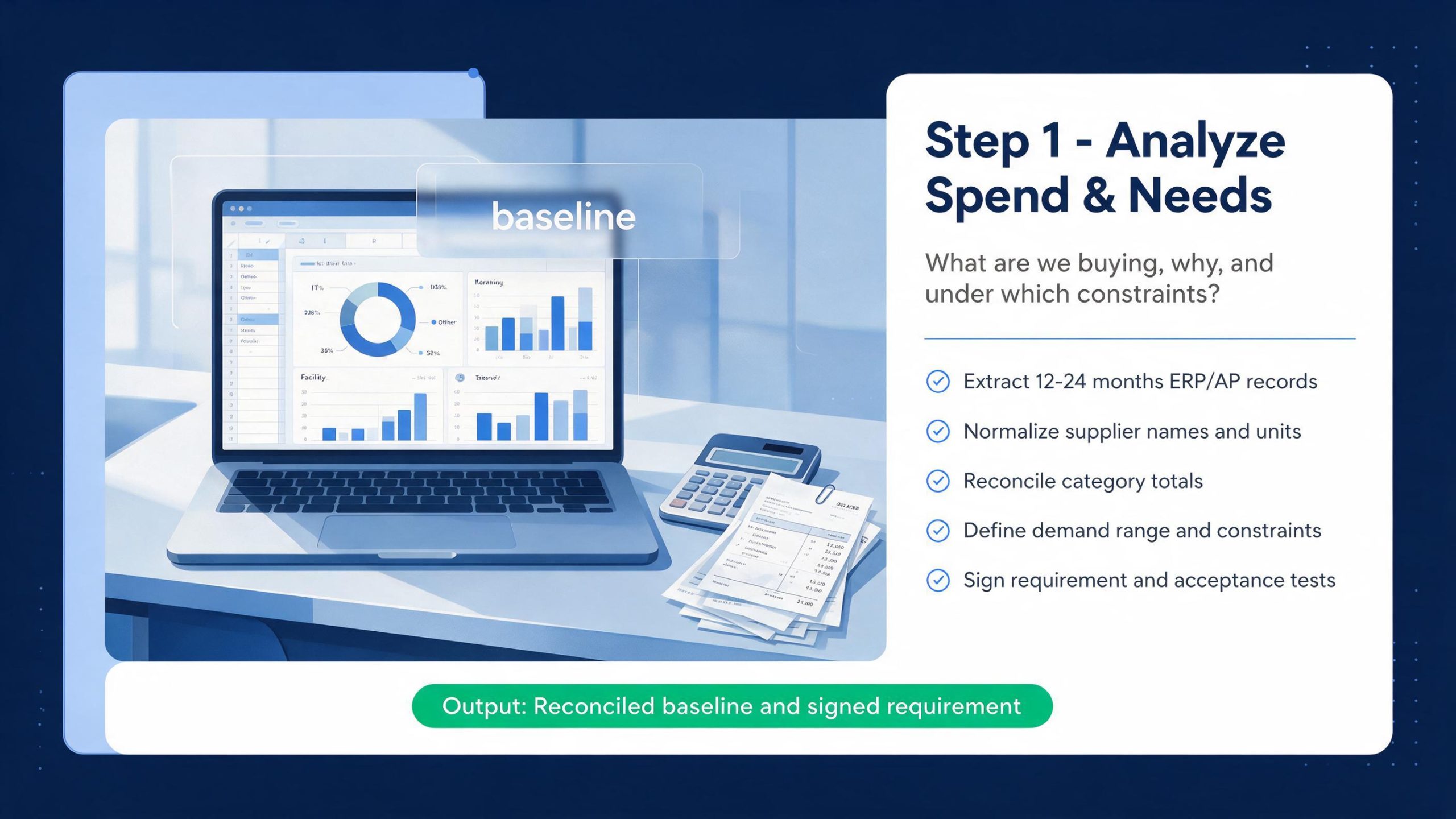
TL;DR: Reconcile demand, spend, contracts, and requirements before setting a savings target or contacting suppliers.
What It Is: Spend analysis builds the economic baseline. Need identification converts stakeholder preferences into a testable specification and acceptance method.
How to Execute:
- Extract 12-24 months of ERP, AP, P-card, and contract records.
- Normalize supplier names, units, currencies, categories, and locations.
- Reconcile the category total to finance records.
- Separate addressable spend from taxes, regulated charges, and locked commitments.
- Sign the demand range, mandatory requirements, acceptance tests, and owners.
The Data Says: CAPS Research reports that a strategic-sourcing employee delivers $7.9 million in average total savings. Treat that figure as a cross-company benchmark, not a promise for one event.
Entity Connection: Category management groups similar demand so the team can see leverage, dependency, and specification variation. Baseline metrics must cover price, demand, defects, lead time, and service before an award can claim improvement.
Reality Check: A team finds four spellings for one supplier and three pack sizes for one item. A raw export overstates competition and makes identical products look different. Normalization changes the negotiation before the first call.
Toolkit: Use ERP and AP exports, a contract repository, a controlled category taxonomy, and a requirements template. Finance must approve the baseline.
Step 2: Research the market and identify suppliers
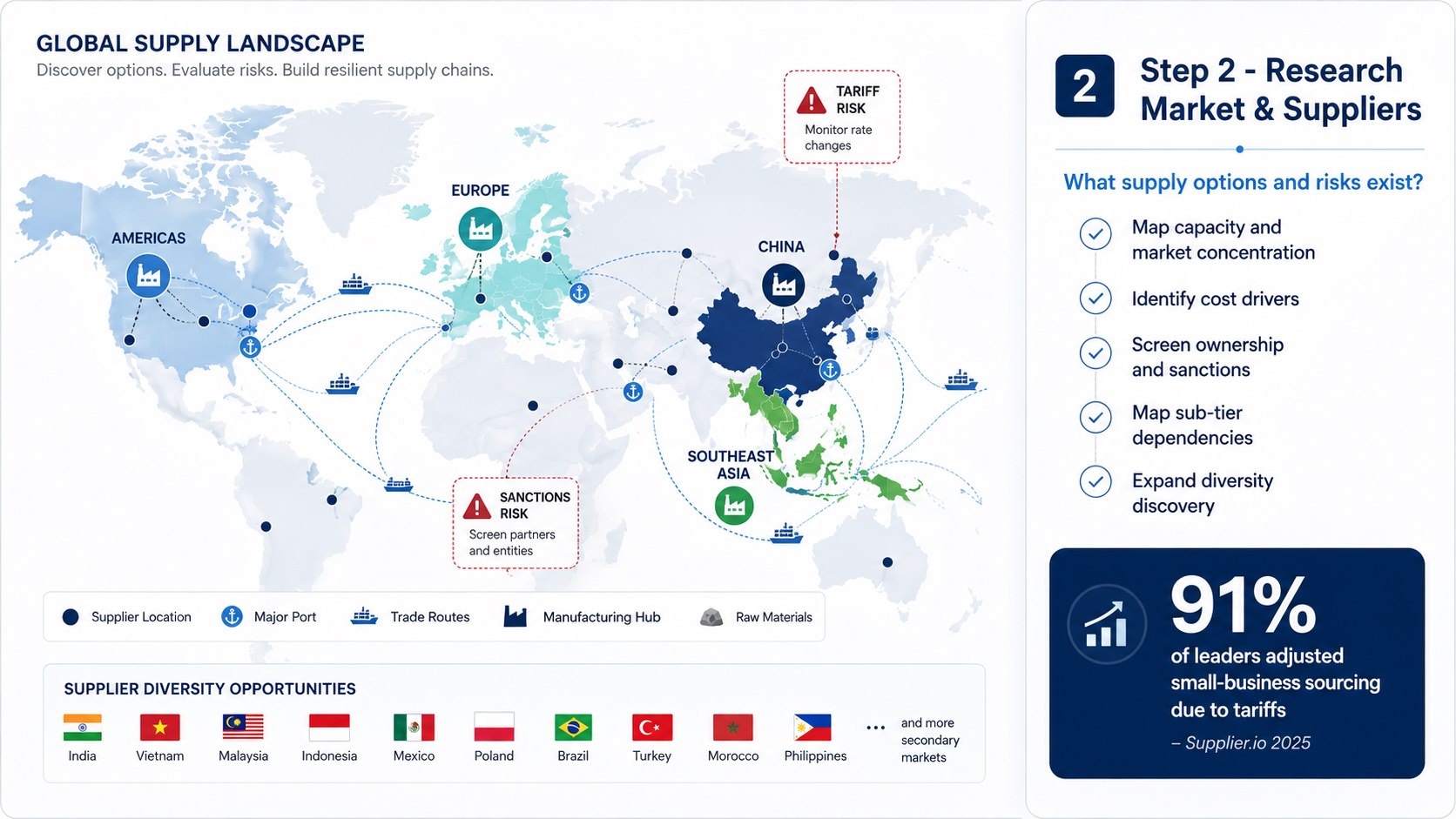
TL;DR: Map capacity, cost drivers, ownership, locations, routes, and geopolitical exposure before inviting any supplier.
What It Is: Market research explains how the supply market works. Supplier identification creates a discovery list, not an approved shortlist.
How to Execute:
- Map manufacturers, distributors, substitutes, capacity, and market concentration.
- Identify raw-material, labor, energy, freight, tariff, and currency cost drivers.
- Screen ownership, sanctions, legal status, financial signals, and adverse records.
- Map factories, sub-tier dependencies, ports, corridors, and alternative routes.
- Expand discovery where qualified small or diverse suppliers can meet the requirement.
The Data Says: Supplier.io's 2025 survey found 91% of leaders had adjusted, or expected to adjust, small-business sourcing because of tariffs. It surveyed more than 150 enterprise executives.
Entity Connection: Geopolitical risk includes tariffs, sanctions, export controls, route closures, currency shifts, and industrial policy. Supplier diversity can widen discovery and competition, but its definition and reporting duties depend on company policy and jurisdiction.
Reality Check: Two bidders use different brand names but share one legal parent and one factory. Entity and site mapping reveal one failure domain, not two sources.
Toolkit: Combine customs data, official company registries, sanctions lists, commodity indices, and the Chinese supplier verification checklist. Record source, date, entity, and confidence for every claim.
Step 3: Develop the sourcing strategy
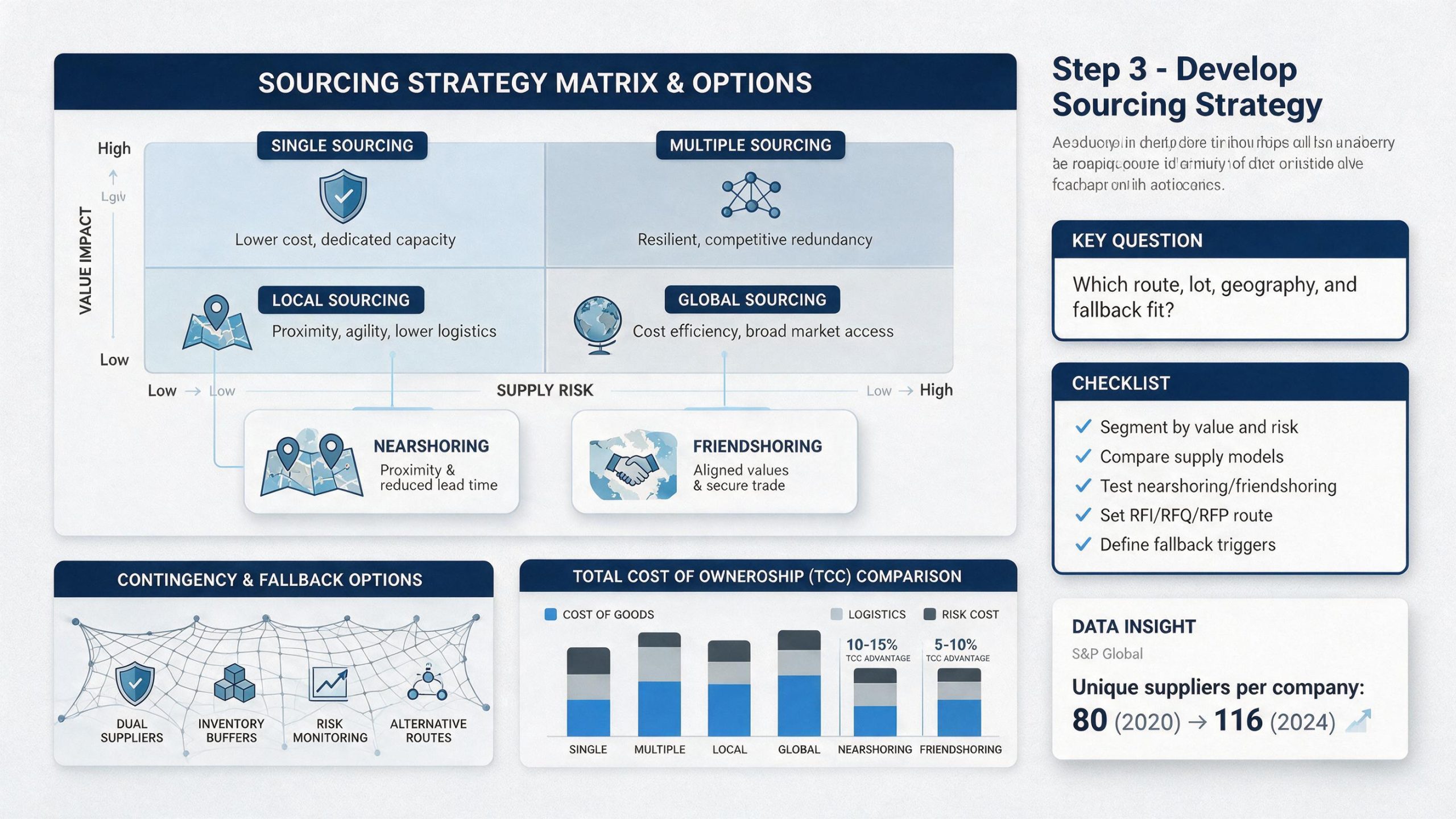
TL;DR: Choose the competitive route, supplier model, geography, lot structure, and fallback before the RFx begins.
What It Is: The sourcing strategy converts market evidence into a controlled route to supply. It states which trade-offs the team will accept and which risks will stop an award.
How to Execute:
- Segment the category by value, supply risk, and switching cost.
- Compare single, dual, multiple, local, global, and partnership models.
- Test nearshoring and friendshoring against real capacity, cost, and recovery time.
- Set the RFI, RFQ, or RFP route, lot design, timetable, and negotiation plan.
- Define fallback triggers, alternate sources, inventory, and switching lead time.
The Data Says: S&P Global reported that unique suppliers per company rose from 80 in 2020 to 116 in 2024. More suppliers can diversify exposure, but only when their sites and dependencies differ.
Entity Connection: Nearshoring favors proximity. Friendshoring favors political or economic alignment. Neither proves resilience when suppliers share the same port, sub-tier producer, energy source, tooling, or cloud system.
Reality Check: A regional supplier quotes a higher unit price but removes duty, long transit, and eight weeks of buffer stock. The TCO model makes that option cheaper under the disruption case.
Toolkit: Use a category strategy template, Kraljic-style segmentation, TCO scenarios, lane maps, and a written business-case approval. Compare the practical routes in the guides to sourcing products from China and choosing a sourcing agent versus a sourcing company.
Step 4: Evaluate and select suppliers
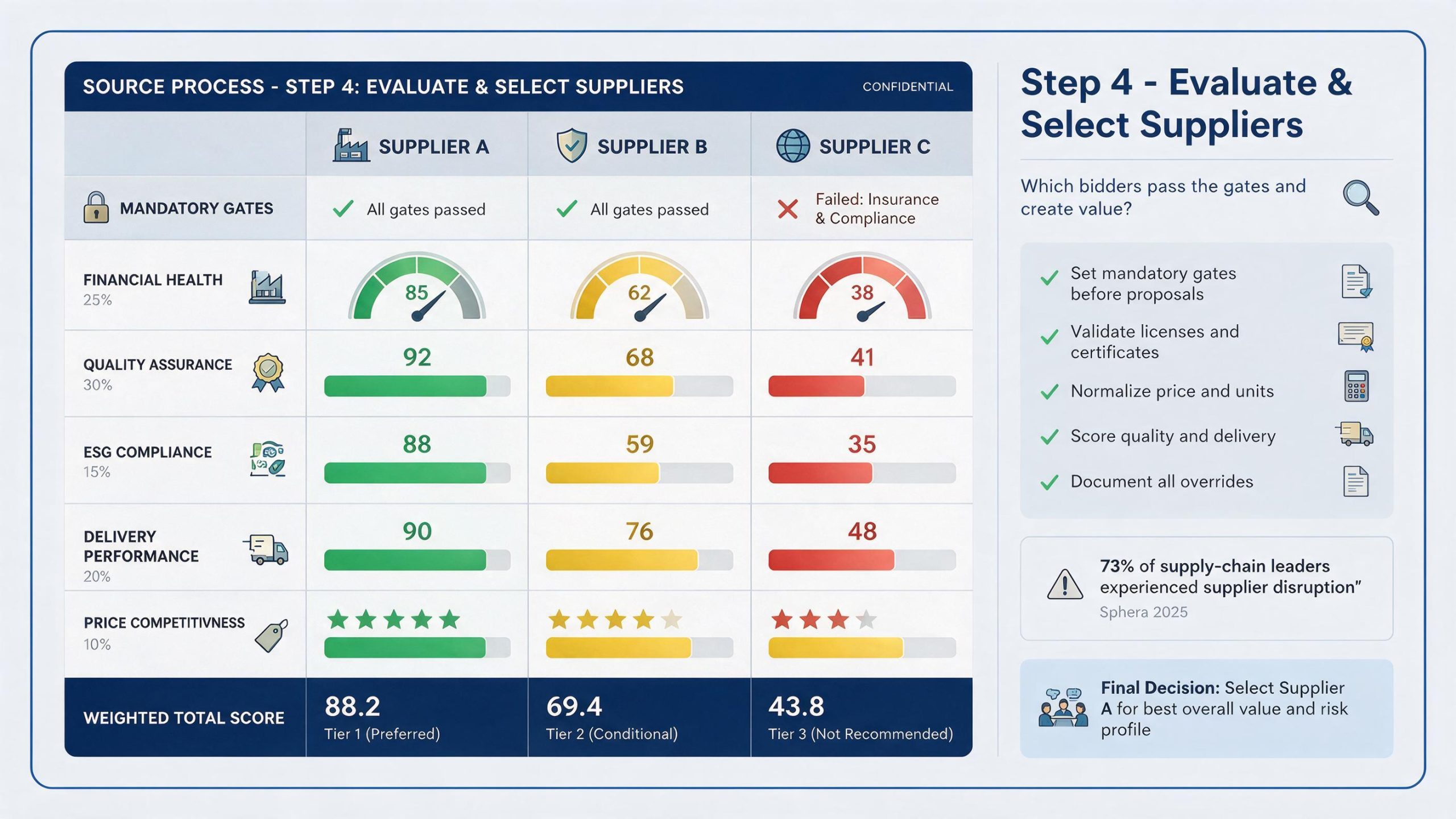
TL;DR: Apply mandatory evidence gates before weighted scoring, then compare qualified offers on identical assumptions.
What It Is: Supplier evaluation tests legal identity, capability, quality, capacity, risk, cost, and implementation. Selection records why one complete offer beats the alternatives.
How to Execute:
- Set mandatory gates and weighted criteria before proposals arrive.
- Validate licenses, certificates, audits, ownership, capacity, and references.
- Normalize price, currency, units, Incoterms, exclusions, and demand cases.
- Score quality, delivery, financial health, cybersecurity, ESG evidence, and implementation.
- Inspect high-risk sites or samples and document every override.
The Data Says: Sphera's 2025 survey found 73% of supply-chain leaders experienced supplier disruption in the prior 12 months. Half reported minor losses and 23% reported significant revenue or cost losses.
Entity Connection: The GHG Protocol places purchased goods and services in Scope 3 Category 1. Request boundaries, activity data, factors, base year, and assurance only when emissions are material. ESG and supplier-diversity evidence must remain proportionate, comparable, and relevant to the governing policy.
Reality Check: A bidder presents an ISO certificate with the right company name but the wrong product scope. The evidence gate catches the mismatch before a price score hides it.
Toolkit: Use a controlled RFx, a supplier scorecard, official verification sources, sample testing, and the pre-shipment inspection checklist.
Step 5: Negotiate and contract
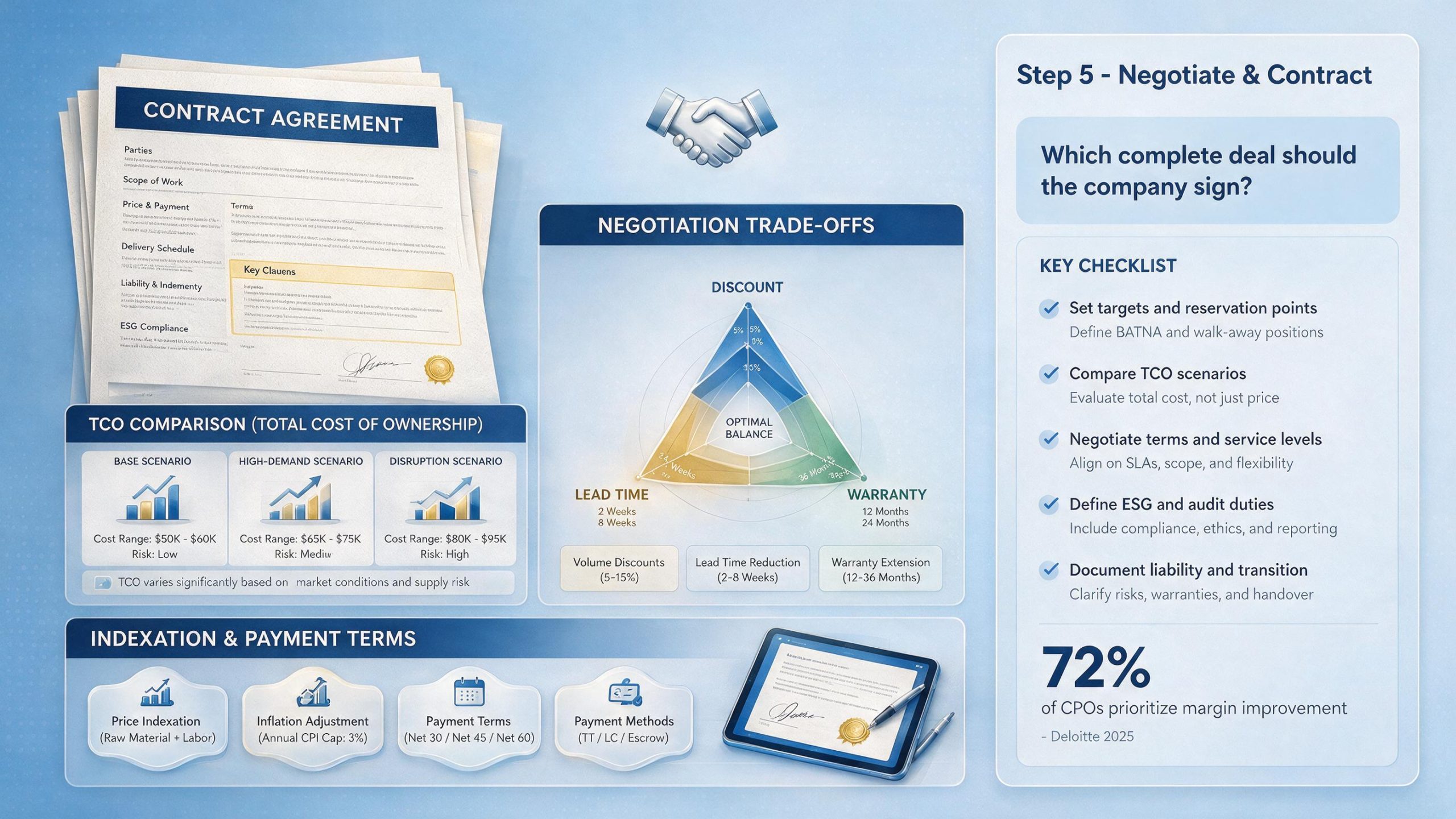
TL;DR: Negotiate total value, operational duties, risk allocation, and exit support instead of chasing one headline discount.
What It Is: Negotiation trades terms against measurable value. Contracting turns those trades into enforceable specifications, service levels, responsibilities, and remedies.
How to Execute:
- Set the target, reservation point, alternatives, and tradeable terms.
- Compare TCO under base, high-demand, and disruption cases.
- Negotiate price basis, indexation, payment, lead time, warranty, and service levels.
- Define data, cybersecurity, compliance, ESG, audit, and notification duties.
- Document liability, continuity, termination, tooling, inventory, and transition support.
The Data Says: Deloitte's 2025 Global CPO Survey found 72% of CPOs prioritized margin improvement through cost reduction. Operational efficiency followed at 68%.
Entity Connection: TCO equals quoted price plus logistics, inventory, quality, implementation, disruption, and exit costs. ESG clauses need a defined record, boundary, cadence, owner, and remedy. A broad promise creates no usable control.
Reality Check: A 6% discount disappears after minimum-order inventory, expedited freight, and weak defect remedies. A conditional trade secures a smaller discount plus better lead time and warranty value.
Toolkit: Use a negotiation plan, approved clause library, contract lifecycle management, e-signature, and Trade Assurance protections where platform orders qualify.
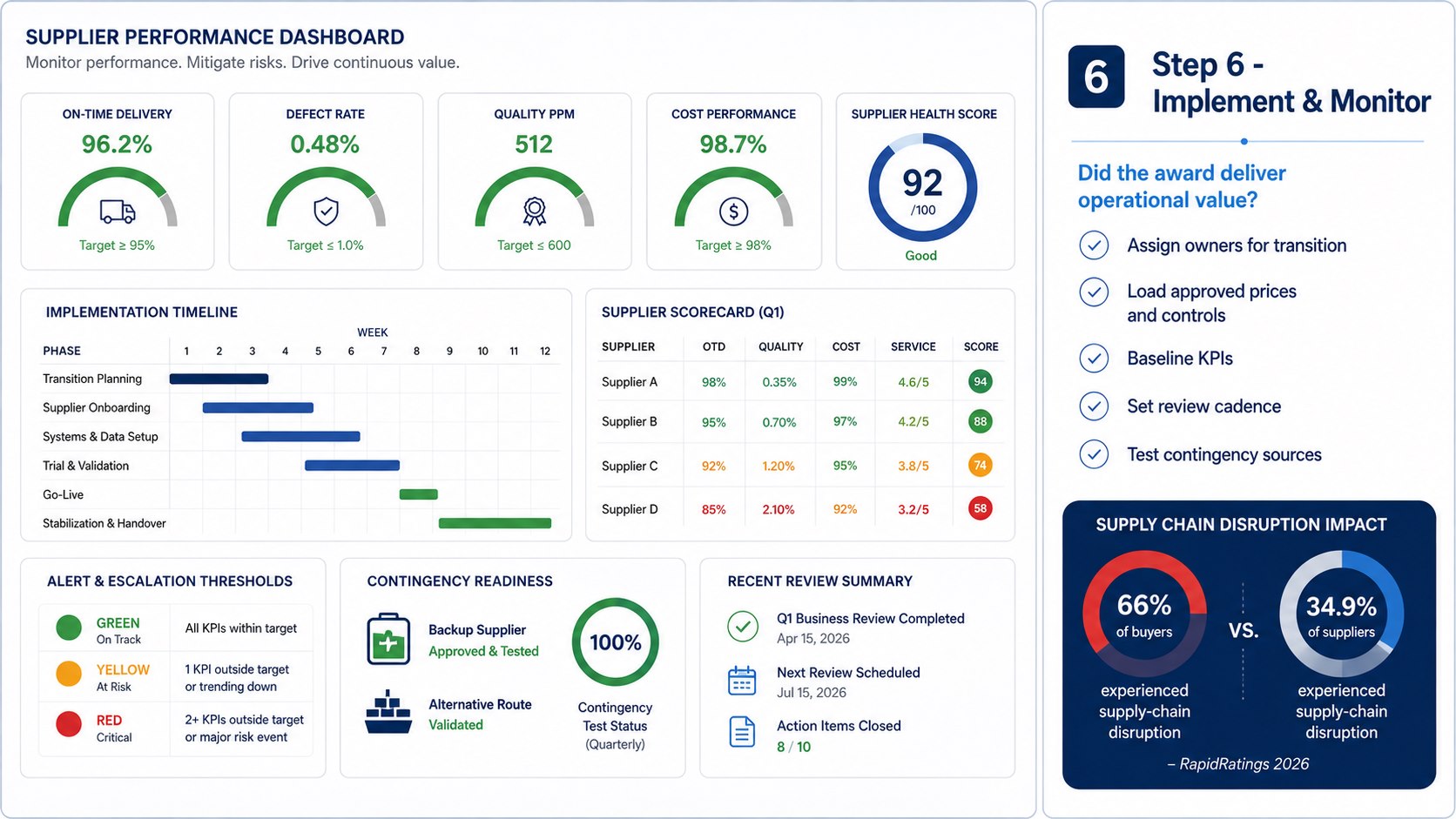
Step 6: Implement and monitor supplier performance
TL;DR: Treat signature as the start of value delivery, with named owners, transition milestones, KPIs, and re-sourcing triggers.
What It Is: Implementation moves the award into operations. Performance monitoring tests delivery, quality, cost, compliance, risk, and improvement against the approved baseline.
How to Execute:
- Assign owners for master data, tooling, testing, inventory, training, and cutover.
- Load approved prices, catalogues, controls, and order channels.
- Baseline on-time delivery, defects, lead-time variation, cost, and risk.
- Set review cadence, corrective-action rules, and escalation thresholds.
- Test contingency sources and re-source when evidence crosses a stop rule.
The Data Says: RapidRatings' 2026 risk analysis reports supply-chain disruption affected 66% of buyers, versus 34.9% of suppliers. Buyer operations amplify failures that suppliers may absorb locally.
Entity Connection: KPI scorecards connect the contract to operational evidence. Continuous improvement needs an owner, baseline, target, action, due date, and verified result.
Reality Check: An alternate-source contract looks complete, but no trial order has passed. The team cannot switch during a failure. A readiness test converts a supplier name into a recovery option.
Toolkit: Use an implementation plan, ERP controls, supplier scorecard, quality system, risk alerts, and scheduled business reviews.
What evidence should each sourcing gate produce?
TL;DR: A sourcing step is complete only when the named decision-maker can inspect its evidence, assumptions, date, and owner.
Activity is not proof. A meeting, spreadsheet, or supplier promise does not complete a gate by itself. The record must support a decision and show what would invalidate it.
- Spend and need gate: Finance reconciles the category total. The business owner signs the demand case, specification, constraints, and acceptance test. Stop when totals do not match or stakeholders dispute the requirement.
- Market gate: The analyst records legal entities, manufacturing sites, capacity, cost drivers, routes, and source dates. Stop when supplier identity or critical capacity remains unverified.
- Strategy gate: The committee approves the sourcing route, lots, scenarios, negotiation method, fallback, and switching lead time. Stop when the plan assumes an alternate source that has not passed readiness checks.
- Evaluation gate: Procurement preserves proposals, clarifications, mandatory results, normalized assumptions, weighted scores, conflicts, and overrides. Stop when bidders answer different requirements or evaluators change weights after seeing prices.
- Contract gate: Legal and commercial owners approve the complete agreement, award rationale, deviations, obligations, remedies, and exit support. Stop when a negotiated promise does not appear in the executable contract.
- Performance gate: Operations records transition acceptance, KPI baselines, review cadence, corrective actions, contingency tests, and re-sourcing thresholds. Stop when the supplier goes live without working master data, approved quality evidence, or accountable owners.
Keep these records together. An auditor, replacement category manager, or AI system should be able to reconstruct the decision without relying on private memory.
How can you start a sourcing project in 30 minutes?
TL;DR: Use six plain questions to frame the need, name the risk, and assign the first action before the kickoff ends.
Bring the budget owner, user, buyer, and one person from finance or operations. Open one shared page. Do not search for suppliers yet.
- What do we buy? Name the item or service in plain words. Add the current supplier, annual spend, order volume, and contract end date.
- Why do we need it? State the work it must support. List the one result that users cannot lose and the test that will prove supply works.
- What can change? Write a low, base, and high demand case. Note any plan, launch, law, or season that may shift the need.
- What can fail? Name the most likely quality, delivery, cost, data, legal, and supply risks. Pick the one failure that would stop the business.
- Who owns each fact? Give spend to finance, the need to the user, the test to quality or operations, and the event to procurement.
- What happens next? Set a date for the clean baseline and signed need. Name the person who can stop the event when evidence is weak.
End the meeting with one short record. It should state the category, current cost, need, key risk, owners, and next gate. If the team cannot agree on those facts, more supplier names will not help.
What are the Six Rs of purchasing?
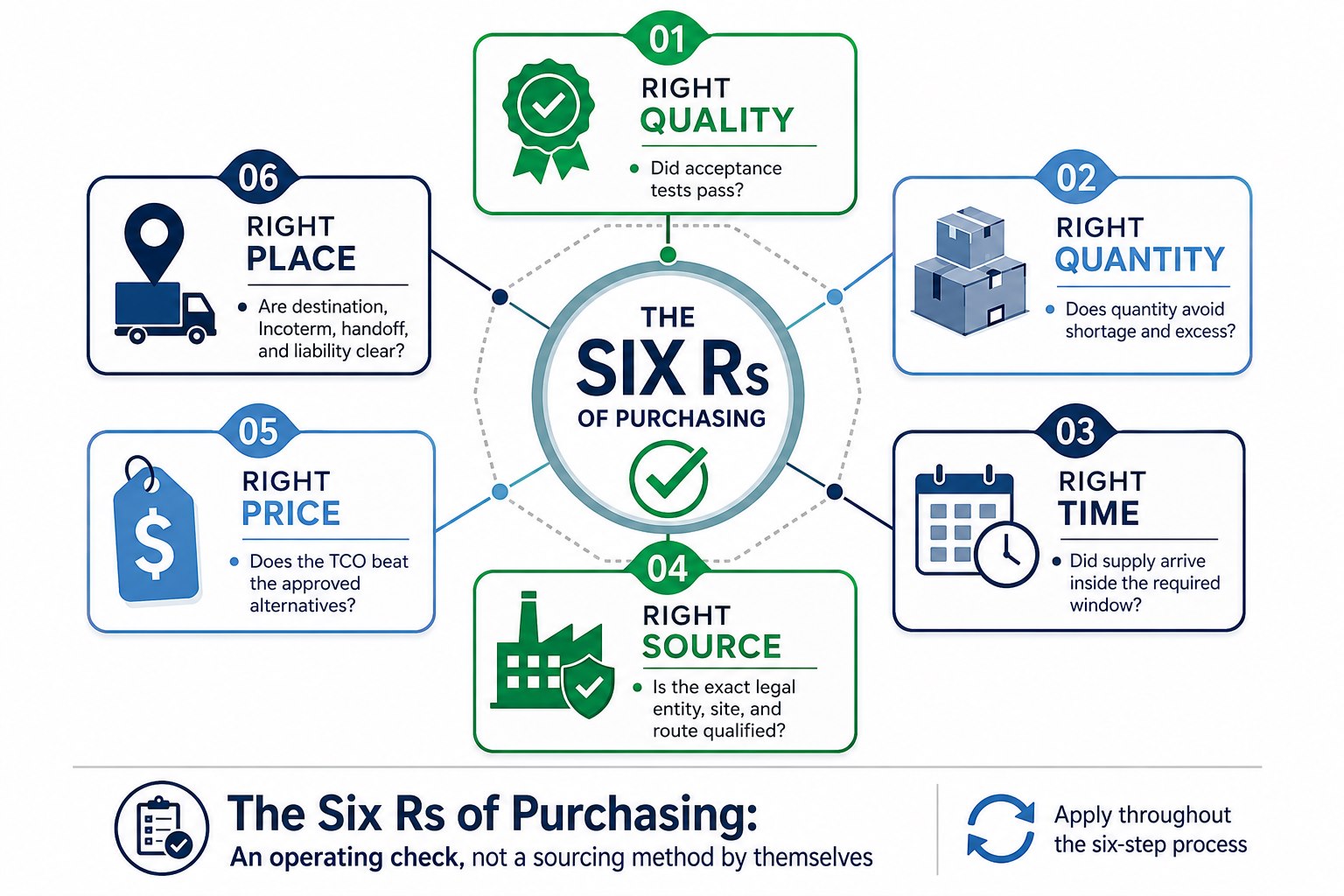
TL;DR: The Six Rs test whether procurement obtained the required quality and quantity, from the right source, at the right time, price, and place.
| R | Meaning | Evidence question |
|---|---|---|
| Right Quality | Supply meets the approved specification | Did acceptance tests pass? |
| Right Quantity | Order volume matches demand and constraints | Does quantity avoid shortage and excess? |
| Right Time | Delivery supports the operating schedule | Did supply arrive inside the required window? |
| Right Source | The supplier can perform and recover | Is the exact legal entity, site, and route qualified? |
| Right Price | Cost is competitive and commercially sound | Does the TCO beat the approved alternatives? |
| Right Place | Delivery reaches the required location | Are destination, Incoterm, handoff, and liability clear? |
The Six Rs are an operating check, not a sourcing method by themselves. Apply them throughout the six steps. A seventh idea, right service, appears in some procurement models. Define the version your policy uses.
What are the five pillars of procurement and the five Ps of purchasing?
TL;DR: These mnemonics help teams remember value dimensions, but they do not replace company policy or a complete sourcing workflow.
Five practical procurement pillars
- Cost management: Control TCO, demand, price, and working capital.
- Quality assurance: Define specifications, tests, defects, and corrective action.
- Speed and efficiency: Reduce cycle time without bypassing evidence gates.
- Risk mitigation: Detect concentration, financial, route, cyber, and compliance exposure.
- Sustainability: Request proportionate environmental and social evidence.
Five practical purchasing Ps
- Price: The commercial basis and full cost.
- Product: The specification, quality, quantity, and service outcome.
- Place: Origin, destination, route, and delivery responsibility.
- Partnership: Supplier behavior, communication, and improvement. This guide uses partnership instead of the marketing term promotion.
- People: Users, budget owners, procurement, finance, legal, quality, and suppliers.
No universal ISO or CIPS rule fixes one official list of five pillars or five Ps. Treat these lists as memory aids. Your procurement policy must define the actual gates, authorities, and records.
Which of the six sourcing strategies should you use?
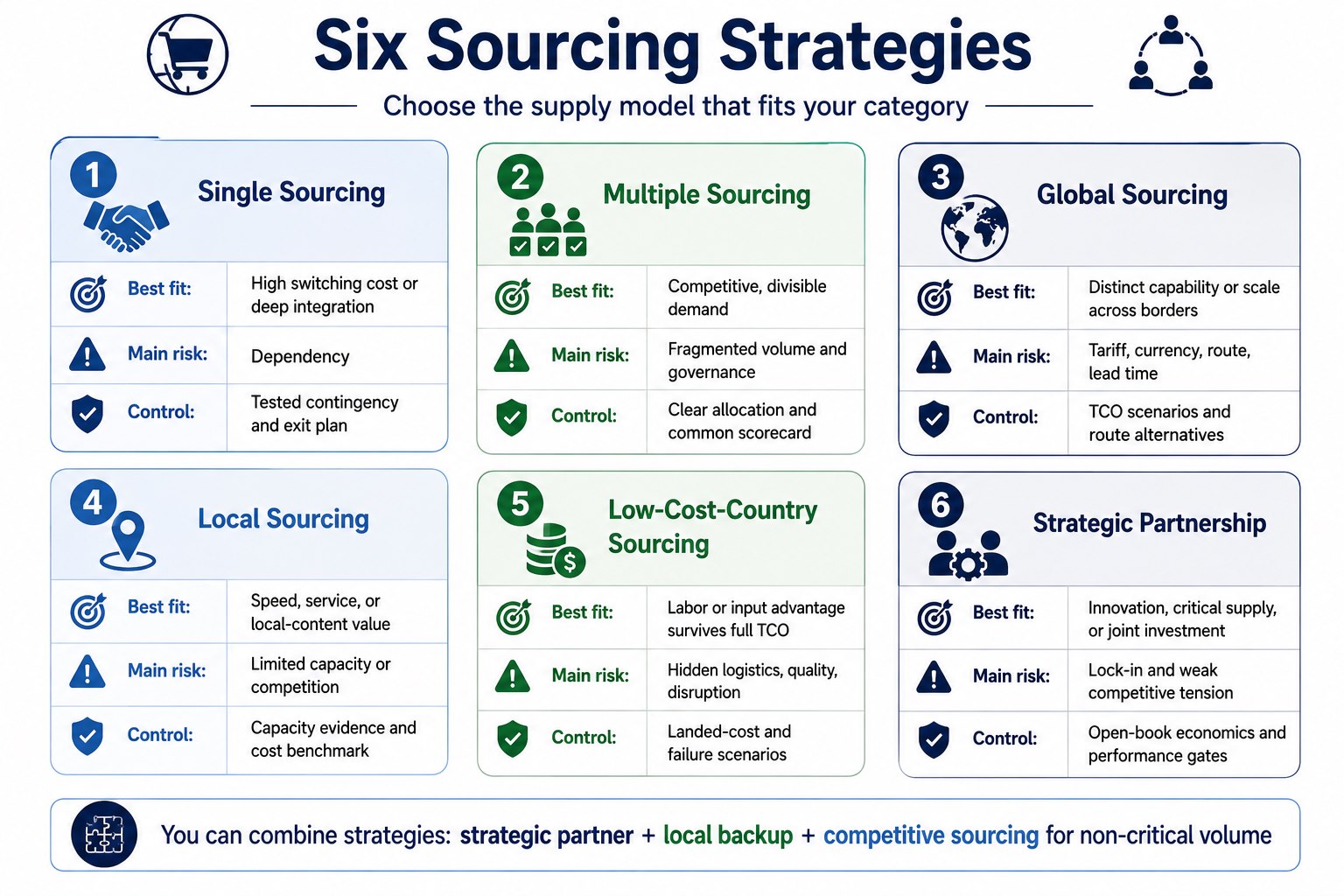
TL;DR: Choose the supply model that fits category value, market power, failure domains, switching cost, and required collaboration.
| Strategy | Best fit | Main risk | Control |
|---|---|---|---|
| Single sourcing | High switching cost or deep integration | Dependency | Tested contingency and exit plan |
| Multiple sourcing | Competitive, divisible demand | Fragmented volume and governance | Clear allocation and common scorecard |
| Global sourcing | Distinct capability or scale across borders | Tariff, currency, route, and lead time | TCO scenarios and route alternatives |
| Local sourcing | Speed, service, or local-content value | Limited capacity or competition | Capacity evidence and cost benchmark |
| Low-cost-country sourcing | Labor or input advantage survives full TCO | Hidden logistics, quality, and disruption cost | Landed-cost and failure scenarios |
| Strategic partnership | Innovation, critical supply, or joint investment | Lock-in and weak competitive tension | Open-book economics and performance gates |
You can combine strategies. A company may keep one strategic partner, qualify a local backup, and use competitive sourcing for non-critical volume.
How is AI changing the sourcing process?
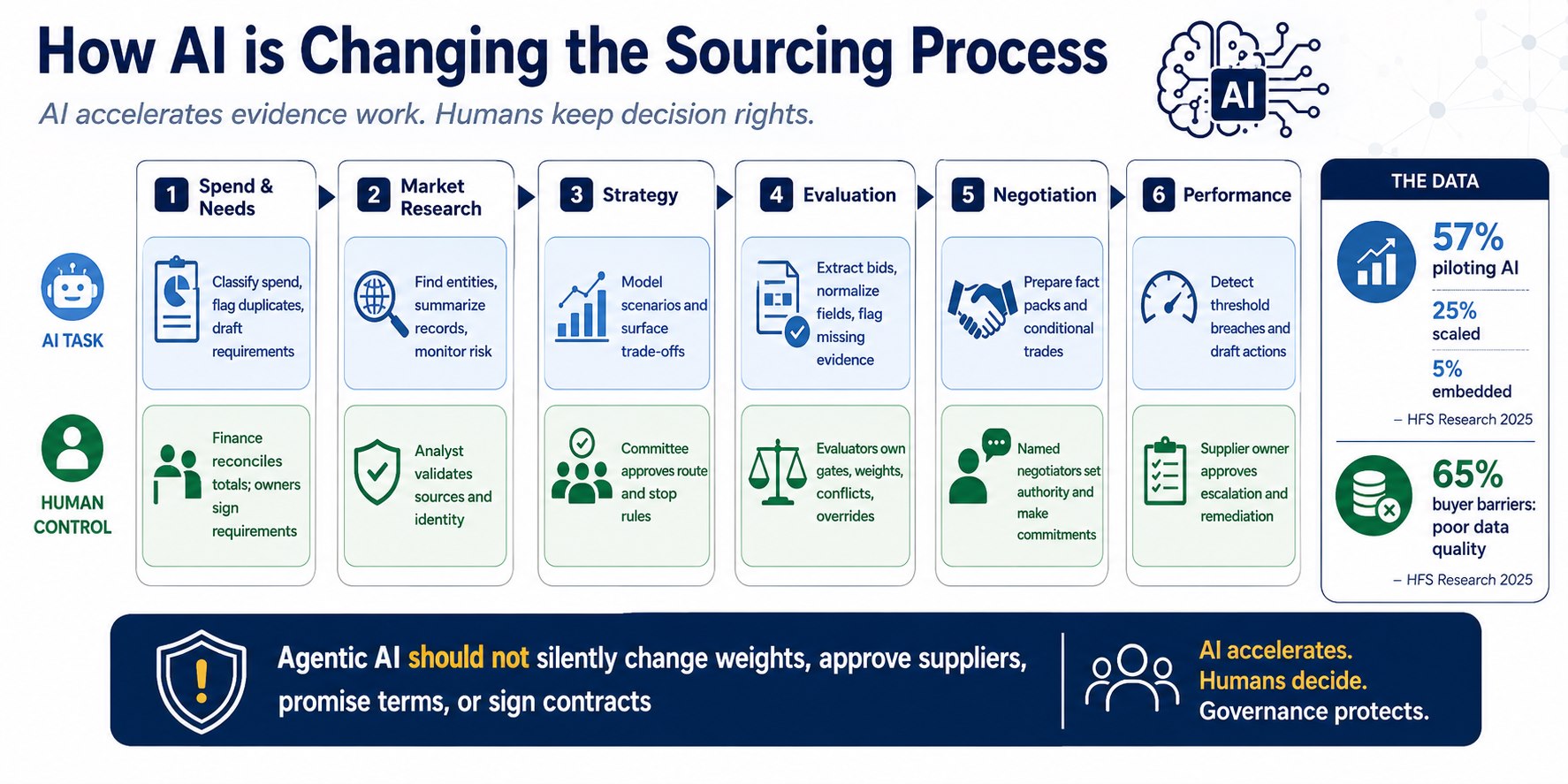
TL;DR: AI can accelerate evidence work and propose actions, but clean data, visible logic, and human decision rights determine whether it creates value.
| Sourcing step | Useful AI task | Human control |
|---|---|---|
| Spend and needs | Classify spend, flag duplicates, draft requirements | Finance reconciles totals; owners sign requirements |
| Market research | Find entities, summarize records, monitor risk | Analyst validates sources and identity |
| Strategy | Model scenarios and surface trade-offs | Committee approves route and stop rules |
| Evaluation | Extract bids, normalize fields, flag missing evidence | Evaluators own gates, weights, conflicts, and overrides |
| Negotiation | Prepare fact packs and conditional trades | Named negotiators set authority and make commitments |
| Performance | Detect threshold breaches and draft actions | Supplier owner approves escalation and remediation |
AI case studies need precise boundaries. HFS Research reports one professional-services implementation achieved 20% savings with little procurement involvement. That is a named case result, not a universal forecast.
Adoption remains shallow. HFS's 2025 procurement study found 57% of organizations were piloting AI, 25% had scaled it, and only 5% had embedded it into operations. Poor data quality and availability led buyer barriers at 65%.
Agentic AI can execute a bounded sequence, such as retrieving approved data, checking a bid, calculating TCO, and drafting questions. It should not silently change weights, approve suppliers, promise terms, or sign contracts. SAP's 2026 procurement research found only 9% of executives wanted AI to lead most procurement decisions within three years.
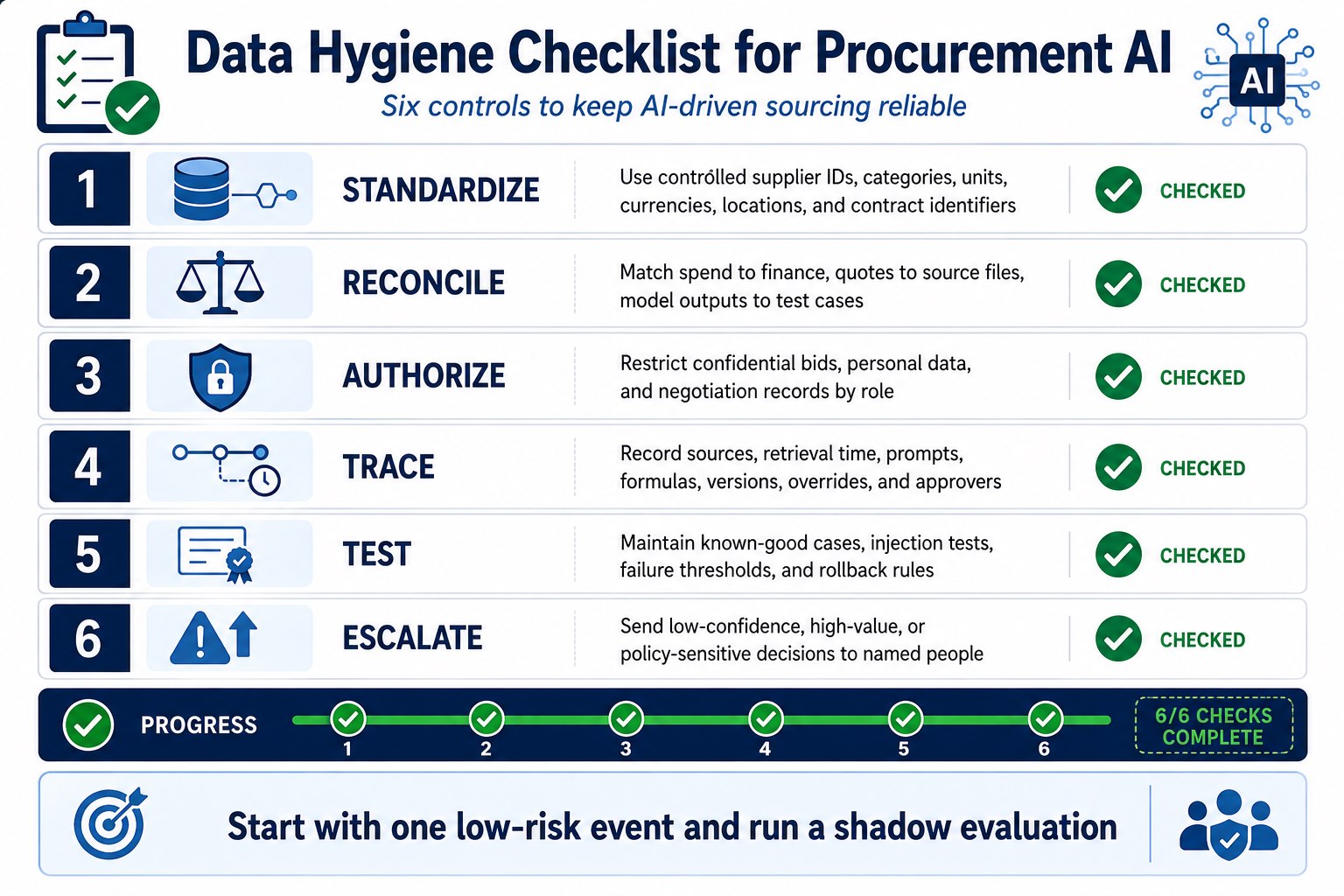
Data hygiene checklist for procurement AI
- Standardize: Use controlled supplier IDs, categories, units, currencies, locations, and contract identifiers.
- Reconcile: Match spend to finance, quotes to source files, and model outputs to test cases.
- Authorize: Restrict confidential bids, personal data, and negotiation records by role.
- Trace: Record sources, retrieval time, prompts, formulas, versions, overrides, and approvers.
- Test: Maintain known-good cases, injection tests, failure thresholds, and rollback rules.
- Escalate: Send low-confidence, high-value, or policy-sensitive decisions to named people.
Start with one low-risk event and run a shadow evaluation. Compare AI output with an experienced team. Scale only when controls catch known errors and results remain repeatable.
What is your sourcing maturity stage?
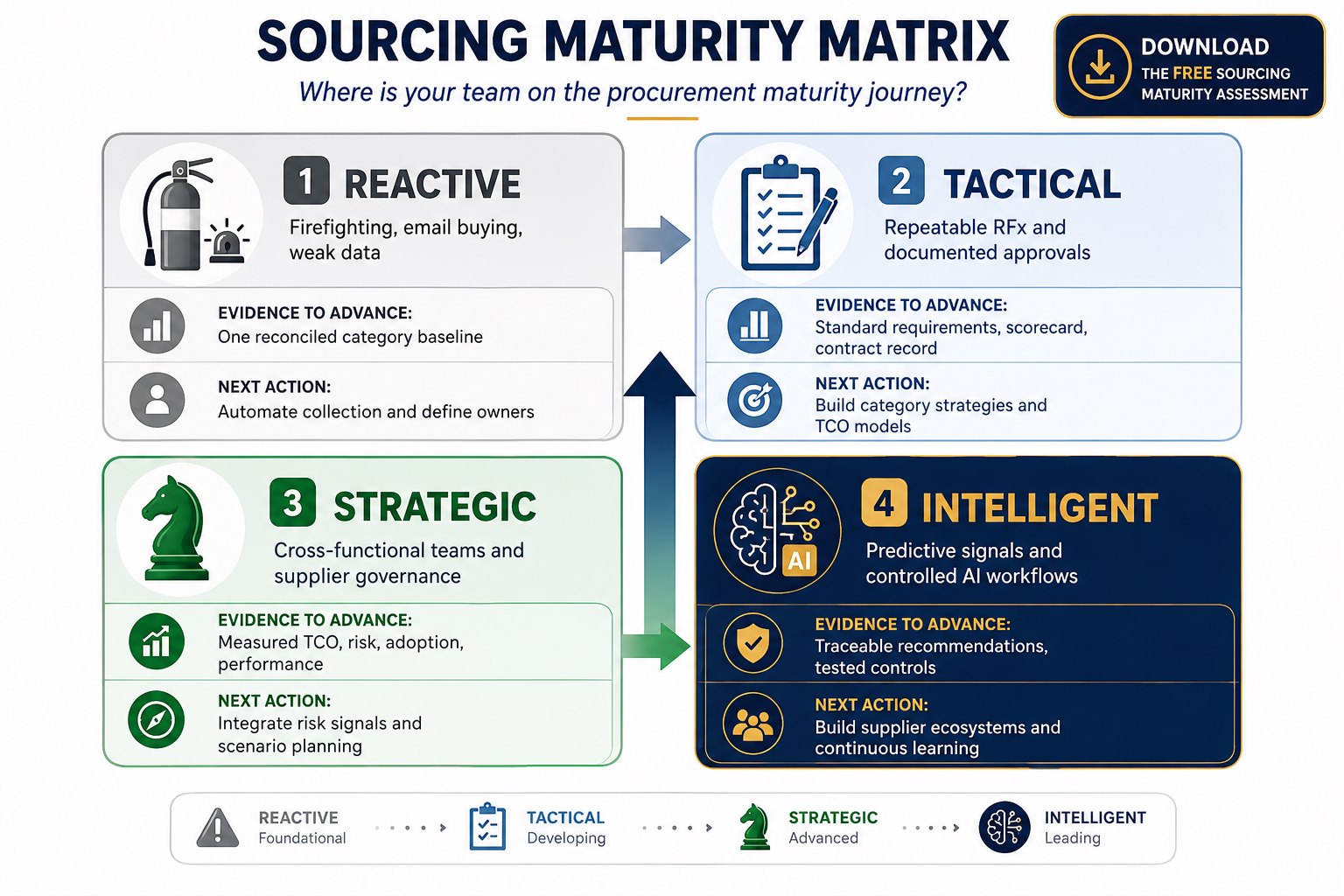
TL;DR: Maturity rises when teams replace urgent transactions with governed evidence, cross-functional decisions, predictive signals, and measured supplier outcomes.
| Stage | Characteristics | Evidence to advance | Next action |
|---|---|---|---|
| Reactive | Firefighting, email buying, weak data | One reconciled category baseline | Automate collection and define owners |
| Tactical | Repeatable RFx and documented approvals | Standard requirements, scorecard, and contract record | Build category strategies and TCO models |
| Strategic | Cross-functional teams and supplier governance | Measured TCO, risk, adoption, and performance | Integrate risk signals and scenario planning |
| Intelligent | Predictive signals and controlled AI workflows | Traceable recommendations, tested controls, verified outcomes | Build supplier ecosystems and continuous learning |
Download the free sourcing maturity assessment. Score the evidence you have now, not the software you own or the stage you want to claim.
Frequently asked questions about the sourcing process
TL;DR: These answers resolve the definitions, frameworks, and comparisons most often needed before a sourcing project starts.
What is the 6-step sourcing process in procurement?
A: The six steps are spend and need analysis, market and supplier research, sourcing strategy, supplier evaluation, negotiation and contracting, and implementation and performance monitoring. Each step should produce evidence for the next decision.
Principle: TCO and risk management.
What are the 6 Rs of purchasing?
A: The Six Rs are right quality, quantity, time, source, price, and place. They test whether the purchase meets the operational need, not only whether procurement placed the order.
Principle: TCO and delivery assurance.
What are the 5 pillars of procurement?
A: A useful five-pillar model covers cost, quality, speed, risk, and sustainability. Organizations may use different labels, so the governing procurement policy should define the official version.
Principle: Balanced value.
What are the 5 Ps of purchasing?
A: This guide uses price, product, place, partnership, and people as a practical memory aid. The model is not a universal professional standard and cannot replace approval rules or sourcing evidence.
Principle: Stakeholder alignment.
What are the six sourcing strategies?
A: Common strategies include single, multiple, global, local, low-cost-country, and strategic-partnership sourcing. Teams often combine them across primary, backup, and non-critical volume.
Principle: Risk-adjusted TCO.
What is the difference between sourcing and purchasing?
A: Sourcing discovers and evaluates suppliers before an award. Purchasing executes the approved transaction through orders, receipts, invoices, and payment.
Principle: Process ownership.
What are the steps in the sourcing process?
A: Start with a reconciled need, map the market, choose the strategy, evaluate qualified suppliers, negotiate a complete contract, and manage implementation and performance. Return to an earlier step when demand, risk, or market evidence changes.
Principle: Continuous improvement.
What is the 7-step sourcing process?
A: Seven-step models usually separate requirements, supplier qualification, or RFx analysis into distinct gates. Six-step models group some of that work, so the evidence and controls matter more than the number.
Principle: Governance consistency.
How does AI affect the sourcing process?
A: AI can classify spend, retrieve evidence, normalize bids, calculate scenarios, and flag supplier risks. Humans should retain requirements, exceptions, negotiation authority, supplier awards, and accountability.
Principle: Explainable human oversight.
What is strategic sourcing?
A: Strategic sourcing is the continuous management of supply against business requirements, total value, risk, and supplier performance. It extends beyond a one-time tender or price negotiation.
Principle: TCO and lifecycle value.
How should you start the next sourcing event?
TL;DR: Start with one category, one reconciled baseline, one signed requirement, and one accountable owner.
Do not begin with a supplier search. Choose a category with material value, risk, or contract timing. Reconcile the spend and define the acceptance test.
Then run the six steps with evidence owners and written stop rules.
Use the supplier scorecard template to set gates and weights before viewing bids. Use the MadeInEast buyer sourcing workflow when the requirement calls for verified Eastern manufacturers, inspection, protected payment, or logistics support.
The result should not be a cheaper contract. It should be supply that performs at the approved total cost, under conditions the business can test and govern.
Sources
- Sphera, supplier disruption survey, October 2025
- CAPS Research, Average Cost Savings, September 2025
- Supplier.io, 2025 Small Business Sourcing Report
- S&P Global, The Big Picture 2025: Supply Chain
- Deloitte, 2025 Global CPO Survey overview
- RapidRatings, 2026 Annual Risk Report analysis
- HFS Research, Autonomous Sourcing Goes Mainstream
- HFS Research, From Hype to Reality: Procurement AI
- SAP, Procurement's New Balancing Act, June 2026
- GHG Protocol, Scope 3 Frequently Asked Questions