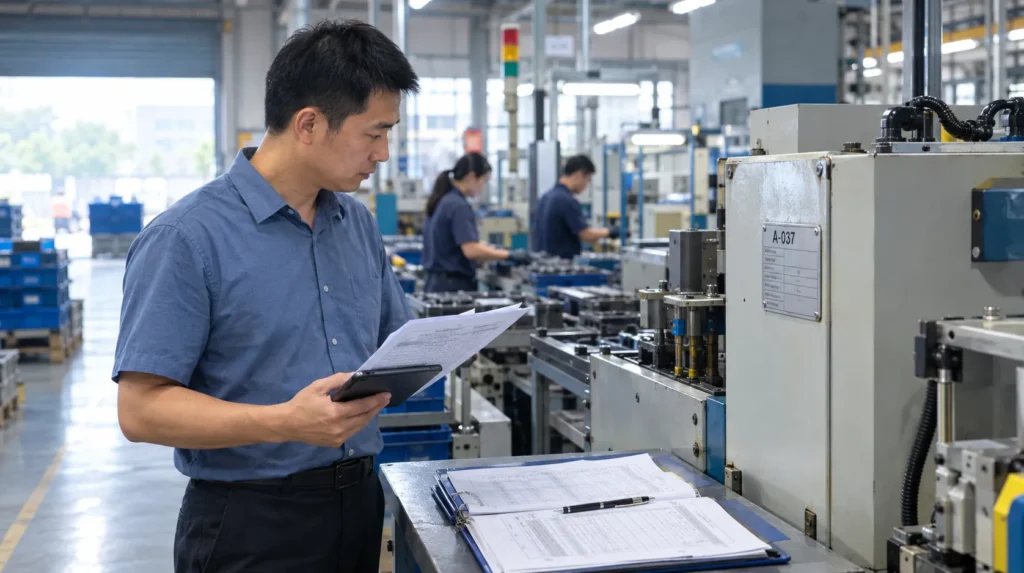
Sourcing products from China means buying directly from Chinese manufacturers instead of through importers or domestic wholesalers — and doing it safely comes down to a repeatable process: define your product precisely, verify the supplier before you pay, order samples, protect your payment, and inspect goods before they ship. This guide walks through each step in order, with links to deeper checklists where a step deserves one. It is written for buyers anywhere in the world, whether this is your first import or your fiftieth.
Why do buyers source from China?
China remains the world’s deepest manufacturing base: dense factory clusters, mature component supply chains, and export logistics that most other sourcing destinations cannot yet match. For a buyer, that translates into three practical advantages — factory-direct pricing without layers of middlemen, the ability to manufacture to your own specification rather than choosing from a catalogue, and capacity that scales from a first trial order to full container loads.
The honest counterweight: you are buying at a distance, in a different legal system, from a supplier you have probably never met. Every risk that matters — wrong entity, wrong quality, lost payment — is manageable, but only if you treat verification, payment protection and inspection as core steps of the process rather than optional extras. That is what the rest of this guide is about.
What are the steps to source products from China?
The full sourcing process has eight steps. Skipping one rarely saves time — it usually moves the cost to a later, more expensive stage.
- Define your product precisely. Materials, dimensions, tolerances, colours, packaging, certifications required in your market. A one-page specification sheet prevents most quality disputes before they exist.
- Research the market price. Collect quotes from several suppliers before negotiating with any of them — without a benchmark, you cannot recognise a good price or a suspicious one.
- Shortlist suppliers. Use a B2B marketplace, trade-show contacts or referrals to build a list of three to five candidates that actually manufacture your product category.
- Verify before you commit. Check the business licence, confirm the company is a manufacturer rather than a reseller, and validate references. Our 10-point supplier verification checklist covers exactly how.
- Order samples. Pay for a sample, evaluate it against your specification, and keep the approved “golden sample” as the contractual quality reference for mass production.
- Negotiate terms, not just price. Agree the minimum order quantity, production lead time, Incoterms, and what happens if goods fail inspection — in writing.
- Order with payment protection. Never pay 100% up front. Use staged payments through a protected channel so your money is not released until agreed conditions are met.
- Inspect before shipment. A pre-shipment inspection at the factory, before the balance payment, is the last moment problems are cheap to fix. See our pre-shipment inspection checklist.
How do you find Chinese manufacturers?
There are three main channels, and they suit different buyers. Online B2B marketplaces are the fastest way to reach many suppliers at once; the trade-off is that open marketplaces mix genuine factories with trading companies reselling at a margin, so the verification burden falls on you. Trade shows such as the Canton Fair let you meet suppliers and handle products in person, at the cost of travel. Sourcing intermediaries — agents and sourcing companies — put a professional between you and the factory; whether that is worth their fee is a real decision, and we compare the options in sourcing agent vs. sourcing company.
Whichever channel you use, the distinction that matters most is manufacturer versus trading company. A factory controls its own production, pricing and quality; a trading company buys from factories and resells to you. Trading companies are not automatically bad — for small mixed orders they can be practical — but you should always know which one you are dealing with, because it changes the price you should expect and the quality control you can demand.
MadeInEast.com takes the curated approach: rather than listing anyone who signs up, the platform lists verified Chinese manufacturers, so the “is this company real?” step is done before a supplier ever appears in search results. You should still follow the process in this guide — curation reduces risk; it does not replace diligence.
How do you verify a supplier before ordering?
Verification is document work plus a little detective work: confirm the Chinese business licence and its 18-character Unified Social Credit Code against the government registry, check that the registered business scope includes manufacturing, ask for a live video tour of the production line, collect references from other international buyers, and make sure the bank account you are asked to pay is registered to the company — not to an individual. Reluctance on any of these is itself an answer.
The complete procedure, including exactly which documents to request and the red flags that should end a conversation, is in the supplier verification checklist.
How do samples work?
Always sample before bulk. Expect to pay for the sample and its courier shipping — legitimate suppliers usually credit the sample cost against your first order. Evaluate the sample against your specification sheet line by line, photograph it, and when you approve it, state in writing that this exact unit is the quality standard for mass production. That “golden sample” becomes the reference point for the pre-shipment inspection later; without it, “the quality is different from the sample” is your word against theirs.
How do you negotiate price, MOQ and terms?
Treat the first quote as an opening position — Chinese suppliers routinely build negotiation margin into initial pricing. Negotiate the minimum order quantity as well as the unit price: many factories will accept a smaller trial order at a slightly higher unit cost, which is usually the right trade for a first transaction. And agree Incoterms explicitly, because they decide who pays for and controls each leg of the journey:
| Incoterm | What the supplier covers | When it makes sense for you |
|---|---|---|
| EXW (Ex Works) | Goods made available at the factory door — everything after that is yours | Only if you have your own freight forwarder handling China-side pickup and export |
| FOB (Free On Board) | Transport to the port and export clearance; you control the main freight | The default choice for most container buyers — you pick the carrier and control cost |
| CIF (Cost, Insurance, Freight) | Freight and insurance to your destination port; risk transfers at loading | Convenient for new buyers, but compare the built-in freight price against your own quote |
| DDP (Delivered Duty Paid) | Door-to-door including your country’s import duties | Hands-off, but you give up visibility of the customs process — use only with suppliers you trust |
How do you pay a Chinese supplier safely?
Two rules cover most payment risk. First, stage the payments: a typical structure is 30% deposit to start production and 70% balance after the goods pass pre-shipment inspection — never 100% up front. Second, only ever pay a corporate account that matches the verified company name; a request to wire money to a personal account, or a sudden “our bank details changed” email, is how most sourcing fraud actually happens.
Order protection removes the remaining gap between “I paid” and “I received what I ordered”. On MadeInEast.com, Trade Assurance holds the transaction to the agreed terms — covering payment security, product quality and on-time shipment, with refunds when an order does not conform. Whatever platform or channel you buy through, make sure something structural — not just trust — stands behind your payment.
How do you control quality before shipment?
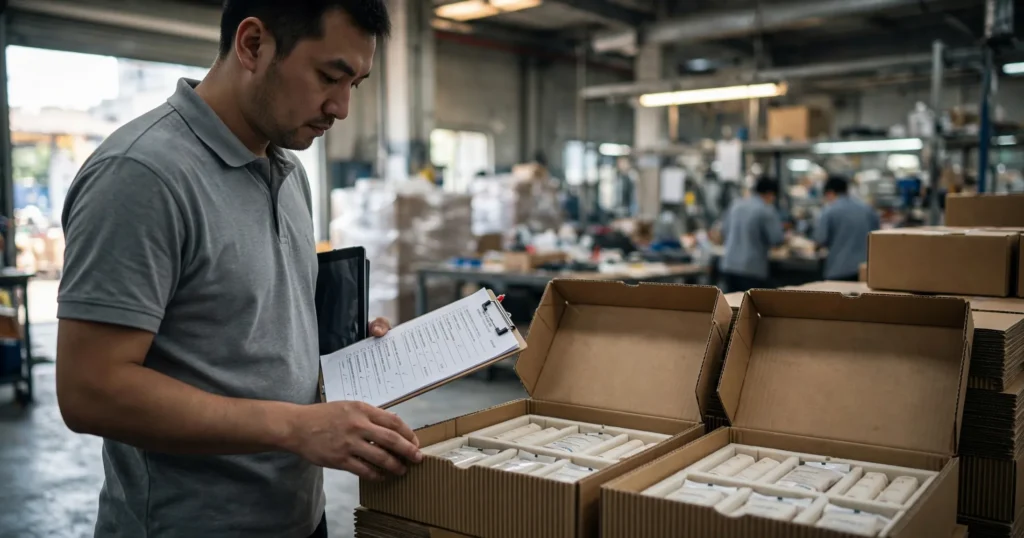
Quality control has three natural checkpoints: before production (are the right materials on hand?), during production at roughly 20–30% completion (is output drifting from spec while there is still time to correct it?), and the pre-shipment inspection when goods are 80–100% complete. The last one is non-negotiable for any order you cannot afford to write off — it is performed against your golden sample and specification, on a statistical sample of finished units, before you release the balance payment.
The full checkpoint-by-checkpoint procedure is in our pre-shipment inspection guide. Buyers on MadeInEast.com can also use the platform’s Inspection Solution, which combines factory production monitoring with independent third-party SGS inspection and delivers the reports to your buyer dashboard.
How does shipping and customs work?
Sea freight is the economic default for anything measured in cubic metres; air freight buys speed for high-value or urgent goods at several times the cost; rail is a middle option on some corridors. Before goods leave the factory, make sure you hold the commercial invoice, packing list and bill of lading (or airway bill), and that the invoice values, HS codes and Incoterms match your purchase order exactly — customs delays are usually documentation errors, not bad luck.
Import duty and tax are set by your own country per HS code, calculated on the customs value of the goods. Look the rate up before you order, not after — it belongs in your landed-cost calculation alongside freight and inspection. If your product or paperwork is complicated, a licensed customs broker at your end is inexpensive insurance.
What mistakes do first-time buyers make?
- Choosing a supplier on price alone — the cheapest quote is often the most expensive order.
- Skipping verification because the conversation “feels professional”. Fraudulent sellers are professional; that is the job.
- Paying 100% up front, or paying a personal bank account.
- Ordering bulk without an approved golden sample.
- Leaving MOQ, lead time and defect terms out of the written agreement.
- Skipping the pre-shipment inspection to save a few hundred dollars on an order worth a hundred times that.
- Forgetting landed cost — duty, freight, insurance and inspection are part of the real price.
Frequently asked questions
Is it safe to source from China?
Yes — for buyers who follow a process. The risks are real but specific: unverified entities, unprotected payments and uninspected goods. Each has a standard countermeasure (verification, staged protected payment, pre-shipment inspection), and buyers who use all three rarely experience the horror stories.
Do I need to visit China to source products?
No. Video factory tours, third-party inspections and protected payment channels let you run the entire process remotely. Visiting helps for large, long-term programmes, but it is not a requirement for buying safely.
How long does the sourcing process take?
As a rule of thumb: one to two weeks to shortlist and verify suppliers, one to three weeks for samples, two to six weeks for production depending on the product, and two to six weeks for shipping depending on mode and destination. First orders take the longest; repeat orders compress dramatically.
What is a realistic minimum order?
MOQs vary by product and factory, from a few hundred units for simple goods to thousands for complex ones. MOQs are negotiable more often than new buyers assume — especially if you frame the first order as a trial with a clear reorder plan.
What if the goods arrive defective?
Your leverage depends on decisions made earlier: an approved golden sample, defect terms in the agreement, an inspection report, and a payment channel with order protection. With those in place you have documented grounds for rework, replacement or refund. Without them, you are negotiating from goodwill.
Ready to put the process to work? See how sourcing works on MadeInEast.com — verified Chinese manufacturers, protected payments and independent inspection for buyers worldwide — or start with what the platform offers buyers.