Quick answer: To verify a Chinese supplier, confirm its exact legal identity in China’s official company registry, check whether its registered scope and real-world facility support its claims, review court and export records, validate product compliance, match the contract and bank beneficiary, approve a reference sample, and inspect the production lot. No marketplace badge or single report replaces this evidence chain.
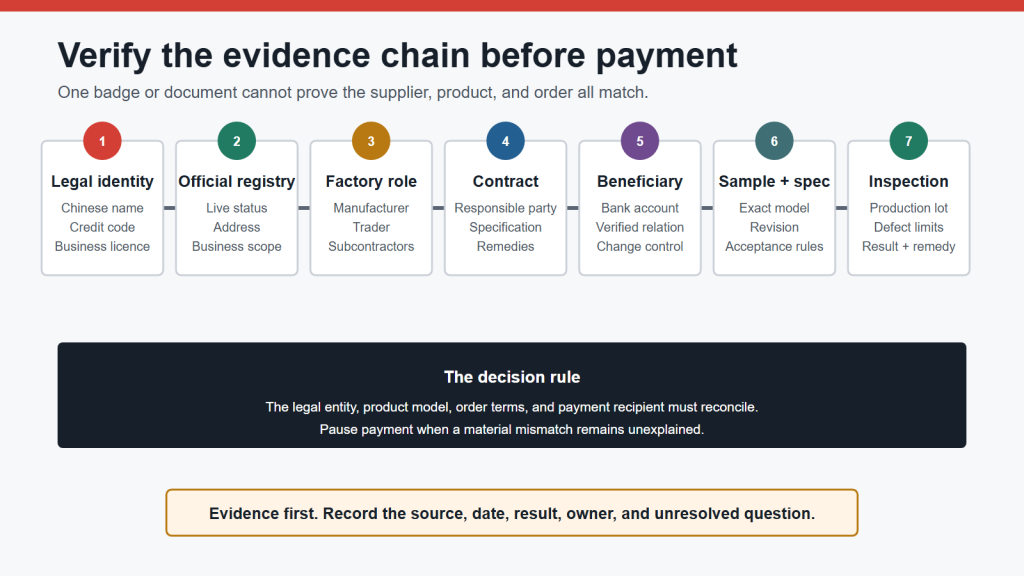
Verification is not a search for one perfect certificate. It is a reconciliation task. The business licence, registry record, quotation, contract, invoice, export documents, bank account, sample, and inspection report should describe the same company, product, and order.
An unexplained mismatch is a reason to pause before sending money.
What should you verify before paying a Chinese supplier?
Verify four things before payment: the company legally exists, it controls or discloses the factory making your product, the exact product can meet your market’s requirements, and the payment recipient has a documented relationship with the contracted supplier. The table below turns those questions into a stop/go screen.
| Evidence | What it answers | Pass condition | Pause or stop condition |
|---|---|---|---|
| Business licence and official registry record | Does the legal entity exist now? | Exact Chinese name and credit code match; status is active | Supplier withholds the licence, or the code and name do not resolve |
| Business scope and facility evidence | Manufacturer, trader, or disclosed hybrid? | Role is consistent across records, quotation, and factory evidence | Supplier claims to own a factory but will not identify or show it |
| Court and enforcement checks | Is there a visible pattern of unpaid judgments or enforcement? | Results are reviewed in context and material cases are explained | Undisclosed enforcement, repeated disputes, or inconsistent explanations |
| Product evidence | Can the exact model meet destination rules and the specification? | Reports identify the model, standard, applicant, lab, and current result | Certificate covers another model, company, market, or expired standard |
| Contract, invoice, and bank evidence | Who is responsible and who receives payment? | Names match, or each difference has a verified legal explanation | Personal account, unrelated beneficiary, or bank change confirmed only by email |
| Sample and inspection plan | How will production be accepted? | Approved reference, defect rules, tests, and inspection timing are written | Supplier resists objective acceptance criteria or independent inspection |
The 10-point Chinese supplier verification checklist
1. Obtain the exact Chinese legal name and business licence
Ask for a clear, current copy of the business licence, called a yingye zhizhao (business licence) in Chinese. Record the Chinese legal name, 18-character Unified Social Credit Code, registered address, legal representative, establishment date, and business scope.
Use the Chinese legal name as the master identifier. English trading names are not unique and may not appear in government systems. A licence image is only the starting document; the next step tests it against the live official record.
2. Check the company in China’s official registry
Search the exact legal name or credit code in the National Enterprise Credit Information Publicity System, which is linked by China’s State Administration for Market Regulation. Compare the live record with the licence and note the company’s current status, registered address, legal representative, scope, reported changes, and disclosed administrative actions.
Registry status proves legal registration, not product quality or factory ownership. Registered capital is also not cash available to repay a buyer. Treat every field as one piece of evidence rather than a platform-style trust score.
3. Determine whether it is a factory, trader, or both
A trading company is not inherently unsafe, and a factory is not inherently reliable. The risk comes from an undisclosed role. Ask the supplier to state in writing which legal entity manufactures the goods, which entity exports them, and whether any process is subcontracted.
Compare that answer with the registered business scope, product range, facility address, and technical knowledge. Request a live video walkthrough that moves from the building entrance to the relevant production line, warehouse, quality area, and current date marker. For a material order, use an independent factory audit rather than relying on a recorded tour.
4. Review court judgments and enforcement records
Search the exact company name in the Supreme People’s Court’s China Judgments Online and the China Enforcement Information Disclosure website. The Supreme People’s Court says the enforcement system publishes information such as judgment defaulters, consumption restrictions, and enforcement cases.
One dispute does not automatically disqualify an established manufacturer. Look at the case type, recency, amount, outcome, and pattern.
An empty search is not a clean bill of health because names, publication rules, access, and coverage can limit results. Ask the supplier to explain material cases and obtain professional Chinese legal due diligence for high-value exposure.
5. Confirm the supplier’s export role and customs identity
If the supplier says it exports directly, request its customs registration details and match the registered name. China’s General Administration of Customs states that importers, exporters, and customs declaration agents must register to make customs declarations.
A factory may lawfully export through a trading company. In that case, identify both entities in the purchase documents and define which one carries contractual responsibility. Commercial shipment data can support a pattern of activity, but it may name an export agent rather than the factory and may not cover every route.
6. Verify product compliance for the destination market
Start with the destination rule, not the supplier’s certificate folder. Identify the law, technical regulation, test standard, lab requirement, label, and responsible local party for the exact product model. Then compare each supplier report with that list.
Check the model number, product photos, applicant, manufacturer, factory address, standard edition, test date, report number, and issuing body. Confirm the report with the issuing lab or official register where available. A report for a similar model or a different factory does not establish compliance for your order.
7. Test manufacturing capability against your specification
Send every shortlisted supplier the same request for quotation and specification. Ask for the process flow, critical equipment, quality checkpoints, production lead time, subcontracted steps, and capacity for your order window. Technical answers should be specific enough to compare across candidates.
Evidence should relate to your product, not a generic factory presentation. For custom goods, confirm tooling ownership, material grade, tolerances, approved substitutions, packaging, and change-control rules in writing.
8. Approve a traceable reference sample
Do not approve mass production from photographs alone. Approve a physical reference sample made with the agreed materials, components, finish, and process. Give it a revision number, sign and date it, photograph it, and keep one controlled copy while the factory keeps another.
The sample does not replace the written specification. It gives both parties and the inspector a physical reference for attributes such as colour, finish, assembly, and workmanship.
9. Reconcile the contract, invoice, and bank beneficiary
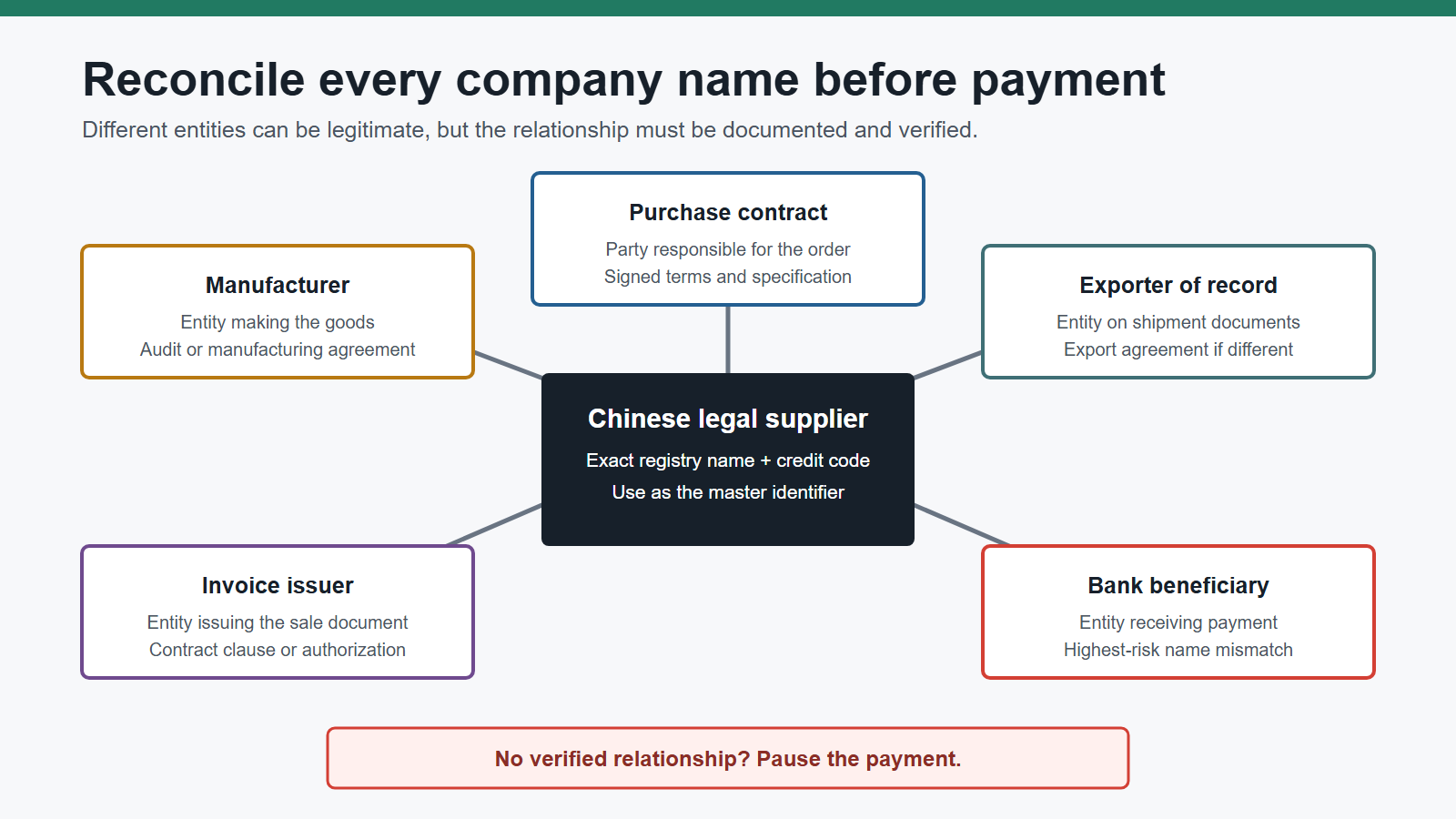
Before payment, match every entity name. The contracted supplier, invoice issuer, manufacturer, exporter, and beneficiary may differ for legitimate reasons, but the supplier must document each relationship. Do not infer a relationship from matching logos, email signatures, or similar English names.
Confirm any bank-detail change by voice or video through a contact method you already held, not a number supplied in the change request. Stop if a supplier pressures you to pay a personal account or an unrelated overseas company without a verified legal basis.
10. Use a factory audit, inspection, and controlled first order
Match the control to the risk. A factory audit answers whether the facility and systems exist.
A pre-shipment inspection checks the finished production lot against the purchase specification and approved sample. They answer different questions.
For lot sampling, require the inspection plan to identify the method and edition. ISO published ISO 2859-1:2026 in January 2026, replacing the 1999 edition.
Define critical, major, and minor defects before inspection, and state what happens after a failed result. The pre-shipment inspection checklist provides the next-stage controls.
Which company names should match before payment?
The names do not always need to be identical, but every difference needs evidence. Use this entity map before approving a deposit.
| Record | Name to capture | If it differs from the supplier | Evidence to request |
|---|---|---|---|
| Business licence and GSXT record | Registered Chinese supplier | Investigate immediately | Current registry record and explanation |
| Purchase contract | Party responsible for the order | Do not rely on an unsigned quotation | Signed agreement naming all responsible parties |
| Commercial invoice | Entity issuing the sale document | Confirm authority to invoice | Contract clause or intercompany authorization |
| Factory record | Entity making the goods | Identify whether work is subcontracted | Audit report, manufacturing agreement, or disclosed supplier list |
| Export declaration | Exporter of record | Common when a factory uses a trader | Export agreement and matching shipment documents |
| Bank account | Payment beneficiary | Highest-risk mismatch | Bank letter plus verified contractual or ownership relationship |
Save the evidence in one order folder and record who checked it, when it was checked, the source URL, the result, and the unresolved question. A screenshot without a date or identifier becomes hard to defend later.
Can customs data prove that a Chinese supplier is legitimate?
No. Customs data can support a history of exporting a product under a named entity, but it cannot prove factory ownership, current capacity, product compliance, quality, or performance on your order. The exporter may be a trader, and dataset coverage may omit routes or fields.
Use shipment records to form questions: Does the product code fit the claimed business? Are destinations and frequency plausible?
Does the exporter name match the documents? Then verify the answers through official company records, factory evidence, samples, contracts, and inspection.
How should Kazakhstan importers adapt the checklist?
Kazakhstan importers should add EAEU product-conformity and local-entity checks to the Chinese supplier workflow. These checks do not replace verification in China; they confirm that the local importer and the exact product can enter and circulate in the destination market.
For a Kazakh importer, broker, distributor, or local contracting party, confirm the exact name and Business Identification Number through Kazakhstan’s eGov legal-entity service and State Revenue Committee taxpayer search. Kazakhstan’s public trade statistics can test product-country plausibility, but the official statistical metadata restricts disclosure of primary data that can identify a respondent. Do not assume a complete public history for every named importer.
For regulated goods, identify every applicable EAEU technical regulation before production. Kazakhstan’s technical-regulation authority explains that EAEU certificates or declarations can be required for import and sale, and that the applicant may need to be a legal entity or individual entrepreneur registered in the EAEU. Confirm the exact product, conformity route, applicant, and current regulation with an accredited body or qualified broker before ordering.
Keep one controlled specification across Chinese, Russian, Kazakh, and English versions. Use bilingual human review for safety instructions, conformity documents, warranties, and dispute terms.
Can AI verify a Chinese supplier for you?
AI can accelerate document extraction, translation, name matching, quotation comparison, and gap tracking. It cannot establish that a licence image is current, a video shows the claimed factory, a certificate covers the exact model, or a beneficiary relationship is lawful without reliable source evidence.
Use AI to prepare and flag decisions, not to make them. A responsible person should approve legal identity, product compliance, contracts, bank changes, payments, audit scope, and inspection outcomes. Keep the source document beside every AI-generated summary so a reviewer can reproduce the conclusion.
What red flags should stop or pause the order?
- Licence withheld or registry mismatch: stop until the exact entity resolves in the official system.
- Factory role changes during negotiation: pause and document the manufacturer, trader, exporter, and subcontractors.
- Certificate covers another model or applicant: treat the product as unverified for your market.
- Personal or unrelated beneficiary: do not pay without verified legal documentation.
- Bank details change by email: confirm through a known independent channel.
- Supplier rejects objective inspection criteria: do not rely on a promise to fix problems after shipment.
- Price excludes material requirements: reissue a comparable quotation rather than choosing an incomplete low bid.
A red flag is a request for evidence, not an invitation to accuse the supplier. End the deal when a material contradiction remains unresolved or the supplier blocks a control needed for your risk level.
Frequently asked questions
How do I know if a Chinese supplier is legitimate?
Confirm its exact Chinese legal identity in GSXT, reconcile its stated role with factory evidence, review court and export records, validate product evidence, and match the bank beneficiary to the contract. Legitimacy is a documented chain, not one badge.
What documents should I ask a Chinese supplier for?
Request the business licence, quotation, specification, product test reports or conformity documents, factory evidence, bank details, sample record, and proposed inspection criteria. Add export or intercompany documents when different entities manufacture, invoice, export, or receive payment.
How do I check a Chinese company’s business licence?
Search the exact Chinese legal name or 18-character Unified Social Credit Code in GSXT, then compare the live status, address, representative, and business scope with the licence image. Do not search only the English trading name.
Does a marketplace verified-supplier badge replace due diligence?
No. A badge describes the platform’s checks at a point in time. It does not prove that the entity on your contract and bank account is the checked entity, or that your exact production lot meets its specification.
How long should supplier verification take?
The duration depends on risk, access, and order complexity. Registry and document checks can begin immediately, while references, audits, samples, compliance work, and corrective answers take longer. Set a completion gate instead of paying because a calendar deadline arrived.
Make the payment decision reproducible
Another buyer or manager should be able to open the order folder and understand why the supplier passed, which risks remain, and who approved them. Use the companion supplier verification worksheet to record the evidence and decision for all ten checks.
If the order warrants independent factory or production checks, review MadeInEast’s inspection options. For the wider sourcing process, see how to source products from China or review the buyer sourcing path before engaging a supplier.