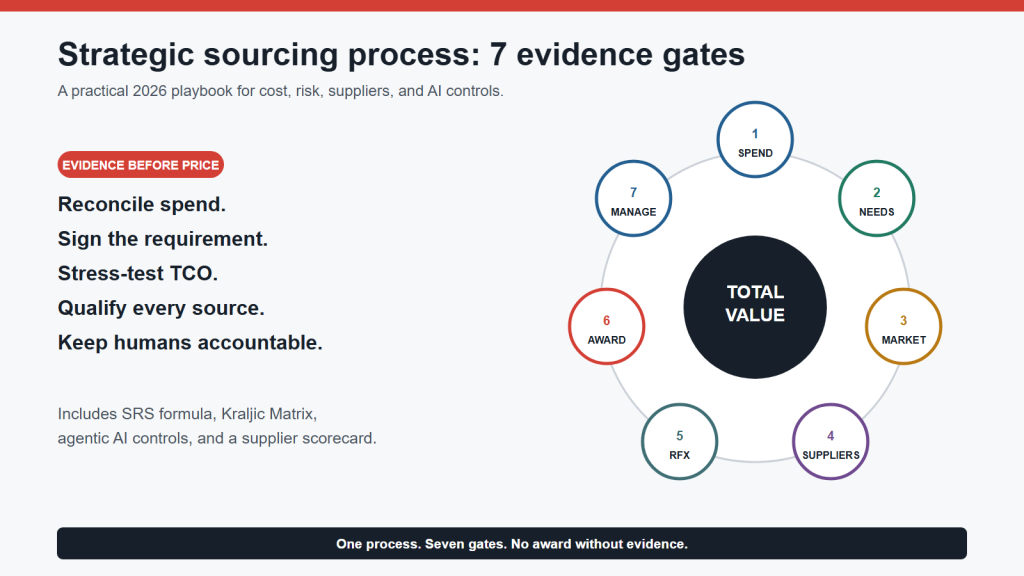
In early May 2025, Suez Canal ship tonnage remained 70% below its 2023 average. One blocked route can erase a low bid. The strategic sourcing process prevents that failure by testing total cost, supplier evidence, geographic exposure, and recovery options before contract award.
Executive briefing
TL;DR: Build the sourcing decision from reconciled facts, total value, and tested recovery options.
- Start with facts: Clean spend data and signed requirements prevent false savings.
- Buy total value: Score cost, quality, continuity, compliance, and implementation together.
- Stress-test resilience: Use the Sourcing Resilience Score (SRS) to expose concentration and unstable lead times.
2026 Data Pulse: Cost pressure and digital ambition now compete for the same attention. Deloitte’s 2025 Global CPO Survey found 72% of CPOs prioritized margin improvement through cost reduction, while 67% prioritized digital transformation and generative AI.
The answer isn’t more software alone; it is a controlled process that gives people and systems reliable evidence.
Definition: Strategic sourcing is a repeatable process for choosing and managing supply based on total value, risk, market evidence, and business requirements rather than unit price alone.
Why must procurement change its sourcing strategy in 2026?
TL;DR: Price-only sourcing fails when routes, rules, demand, and supplier capacity can change before the contract delivers value.
Situation: Procurement once treated the lowest compliant bid as the main prize.
Complication: Geopolitical fragmentation, route disruption, sustainability evidence, and volatile demand now alter total cost after award.
Question: How can a CPO protect margin without paying for vague “resilience”?
Answer: Run seven evidence gates, price disruption scenarios, and fund only recovery options that pass a readiness test.
| Activity | Core question | Typical output | Time horizon | Success measure |
|---|---|---|---|---|
| Sourcing | Who can meet this requirement? | Qualified shortlist and offer comparison | Event-based | Fit, competition, and award quality |
| Purchasing | How do we place and settle the order? | PO, receipt, invoice, and payment | Transactional | Accuracy, cycle time, and compliance |
| Strategic sourcing | What supply model creates the best total value? | Category strategy, contract, risk plan, and scorecard | Continuous | TCO, continuity, quality, risk, and innovation |
This playbook makes each gate auditable. It also shows where AI can accelerate analysis without taking decision authority from accountable people.
What is the difference between sourcing, purchasing, and strategic sourcing?
TL;DR: Sourcing finds and evaluates supply, purchasing executes approved transactions, and strategic sourcing continually improves category value and risk.
Sourcing ends with a supply decision. Purchasing turns that decision into requisitions, purchase orders, receipts, and payments.
Strategic sourcing connects both activities to category strategy, total cost of ownership (TCO), supplier risk management, and measurable business outcomes.
The distinction matters because a fast PO cannot repair a poor award. Likewise, a clever negotiation creates little value when users buy outside the contract.
What are the seven steps in the strategic sourcing process?
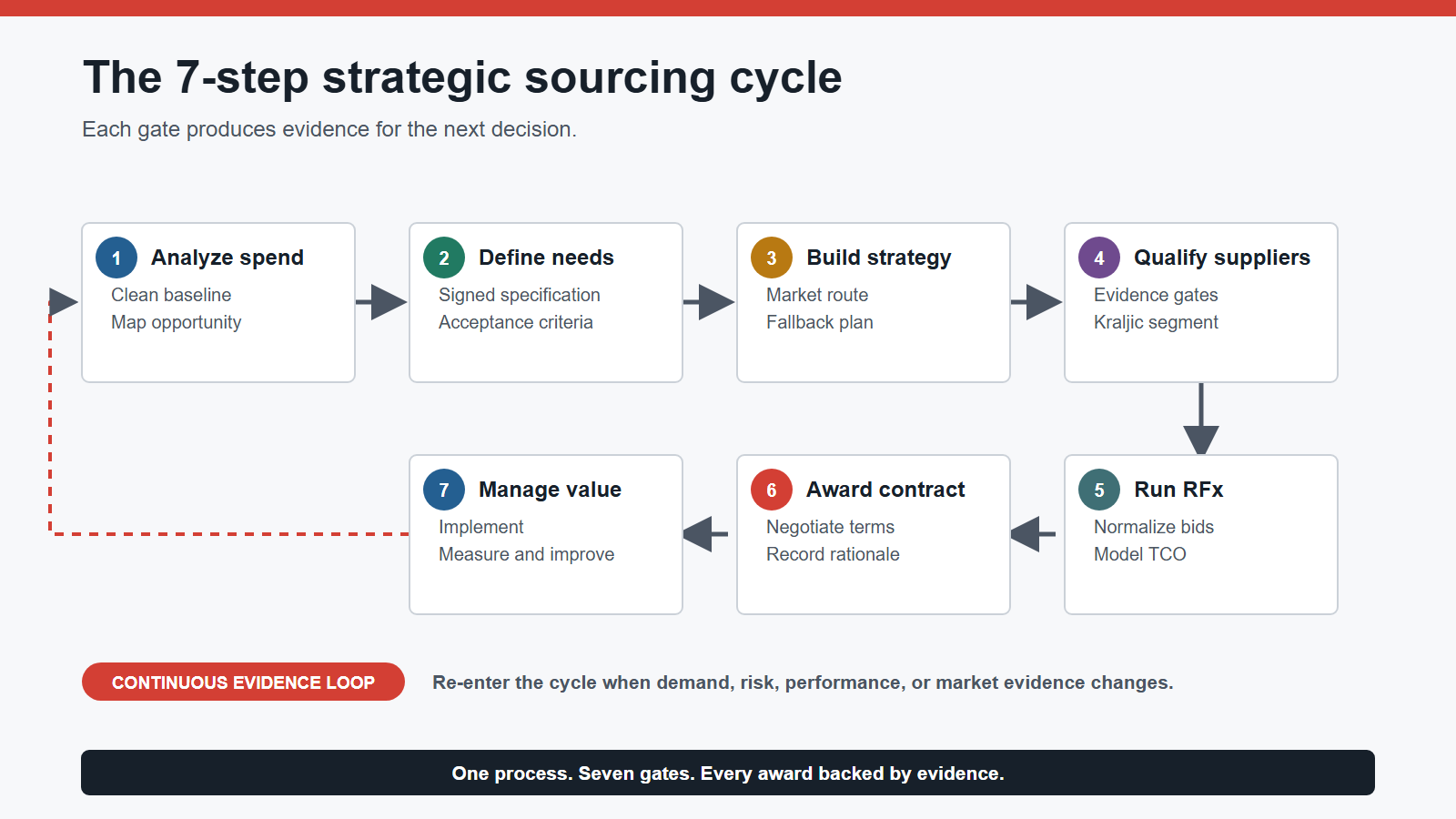
TL;DR: The seven steps move from spend evidence to requirements, market strategy, supplier qualification, RFx analysis, contracting, and continuous performance management.
The sequence creates decision gates. A team can revisit an earlier gate when evidence changes, but it should not skip one. Each step below states the decision, required evidence, tools, data point, and 2025 disruption lesson.
| Step | Decision | Main output | Micro-intent |
|---|---|---|---|
| 1. Analyze spend | Is this category worth sourcing now? | Clean baseline and opportunity statement | Diagnose |
| 2. Define requirements | What outcome must supply deliver? | Signed specification and constraints | Align |
| 3. Build strategy | Which market route fits the category? | Category and go-to-market strategy | Compare |
| 4. Qualify suppliers | Which suppliers deserve an invitation? | Evidence-backed shortlist | Evaluate |
| 5. Run RFx | Which offer creates the best total value? | Normalized bid and TCO model | Compare |
| 6. Negotiate and award | Which deal should the company sign? | Executable contract and award record | Negotiate |
| 7. Implement and manage | Did value reach operations? | Transition plan and supplier scorecard | Validate |
Step 1: Analyze spend and choose the category
TL;DR: Build a clean baseline before setting a savings target or contacting suppliers.
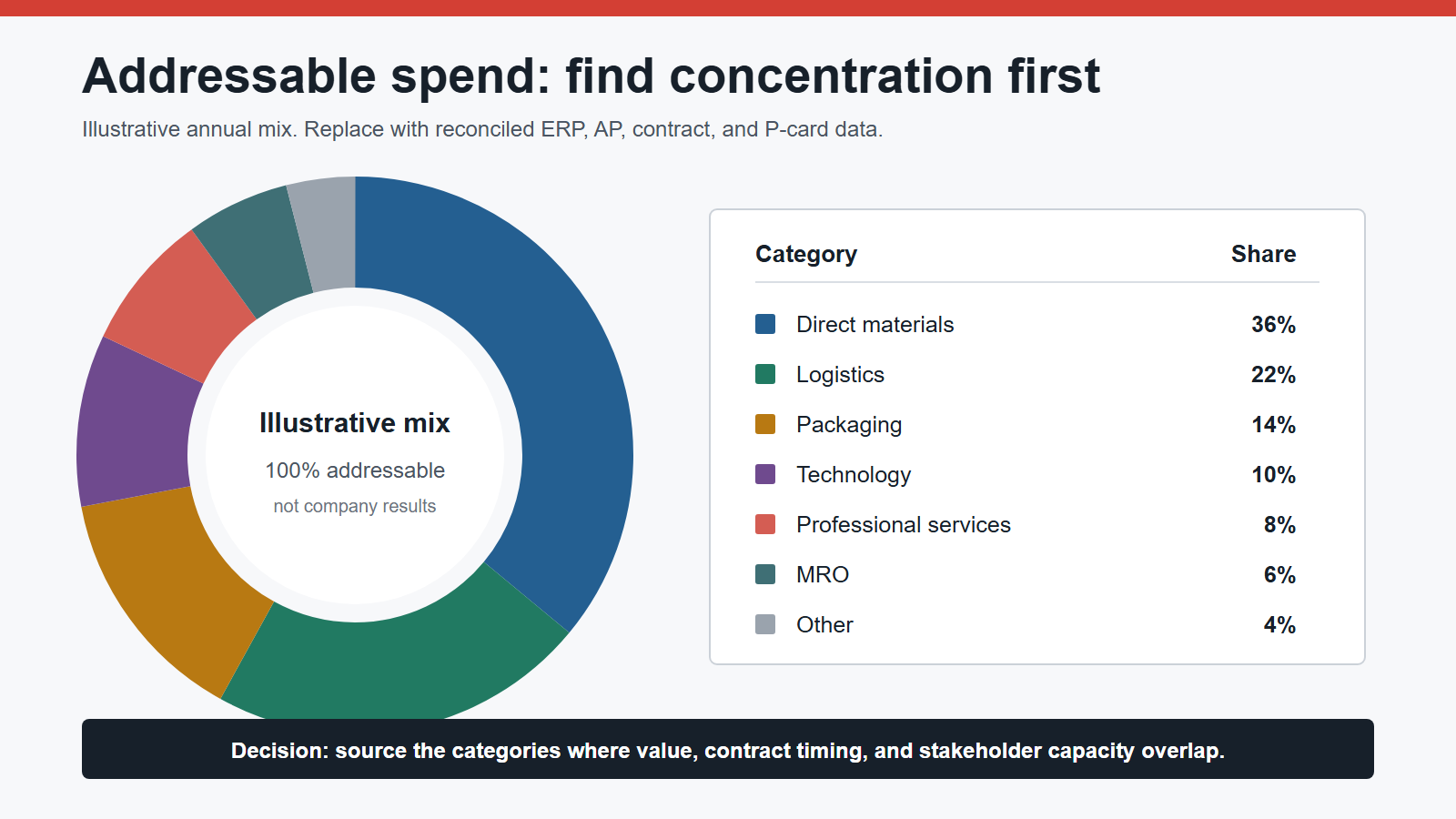
What and why: Spend analysis shows demand, price, supplier, business-unit, and location patterns. It separates addressable spend from taxes, regulated charges, and locked commitments.
How:
- Extract records. Pull 12–24 months from ERP, P-card, AP, and contract systems.
- Normalize names. Map duplicate supplier names to one legal parent.
- Classify spend. Use a category taxonomy and flag low-confidence mappings.
- Reconcile totals. Match the spend cube to the general ledger.
- Select the event. Score value potential, risk, contract timing, and stakeholder capacity.
Toolkit: Use ERP exports, contract repositories, spend-classification tools, relevant industry sourcing reports, and the current buyer sourcing guide library. SAP Ariba, Coupa, or another source-to-pay platform can assist, but finance must reconcile the baseline.
The data says: Deloitte reports that 57% of surveyed CPOs identified siloed ways of working as a barrier to value delivery. A shared baseline gives finance, operations, and procurement one version of the category.
2025 reality check (scenario): Red Sea detours change lane economics during live contracts. A prepared team uses lane-level spend, carrier, Incoterm, and surcharge fields instead of debating one blended freight number.
Step 2: Define the business requirement
TL;DR: Translate stakeholder preferences into testable outcomes, mandatory gates, and forecast scenarios.
What and why: A weak requirement invites incomparable bids and expensive change orders. A good requirement states the outcome, demand range, service level, acceptance method, and owner.
How:
- Name stakeholders. Include the user, budget owner, quality, legal, security, ESG, and operations.
- Separate needs. Mark every requirement mandatory, scored, or optional.
- Model demand. Provide base, high, and low cases with assumptions.
- Define acceptance. State tests, service levels, evidence, and remedies.
- Freeze the baseline. Obtain written approval before releasing an RFx.
Toolkit: Requirements libraries, specification management, demand-planning systems, and collaborative intake workflows reduce email drift. Map each requirement to the site’s five-step sourcing workflow and store it with an owner and evidence type.
The data says: Deloitte found top performers allocated up to 24% of procurement budgets to technology. That investment only helps when systems receive stable requirements and governed data.
2025 reality check (scenario): A fixed “30-day delivery” field can conceal routing assumptions. A resilient requirement defines origin, destination, route alternatives, recovery time, and responsibility for disruption costs.
Step 3: Analyze the market and choose a sourcing strategy
TL;DR: Match the sourcing route to market power, supply risk, geography, and switching cost.
What and why: Supply-market analysis tests whether competition, negotiation, supplier development, dual sourcing, nearshoring, or friendshoring fits the category. The cheapest route is not always the lowest-risk route.
How:
- Map the market. Identify capacity, cost drivers, substitutes, entrants, and concentration.
- Model location risk. Compare country, port, route, tariff, sanctions, and currency exposure.
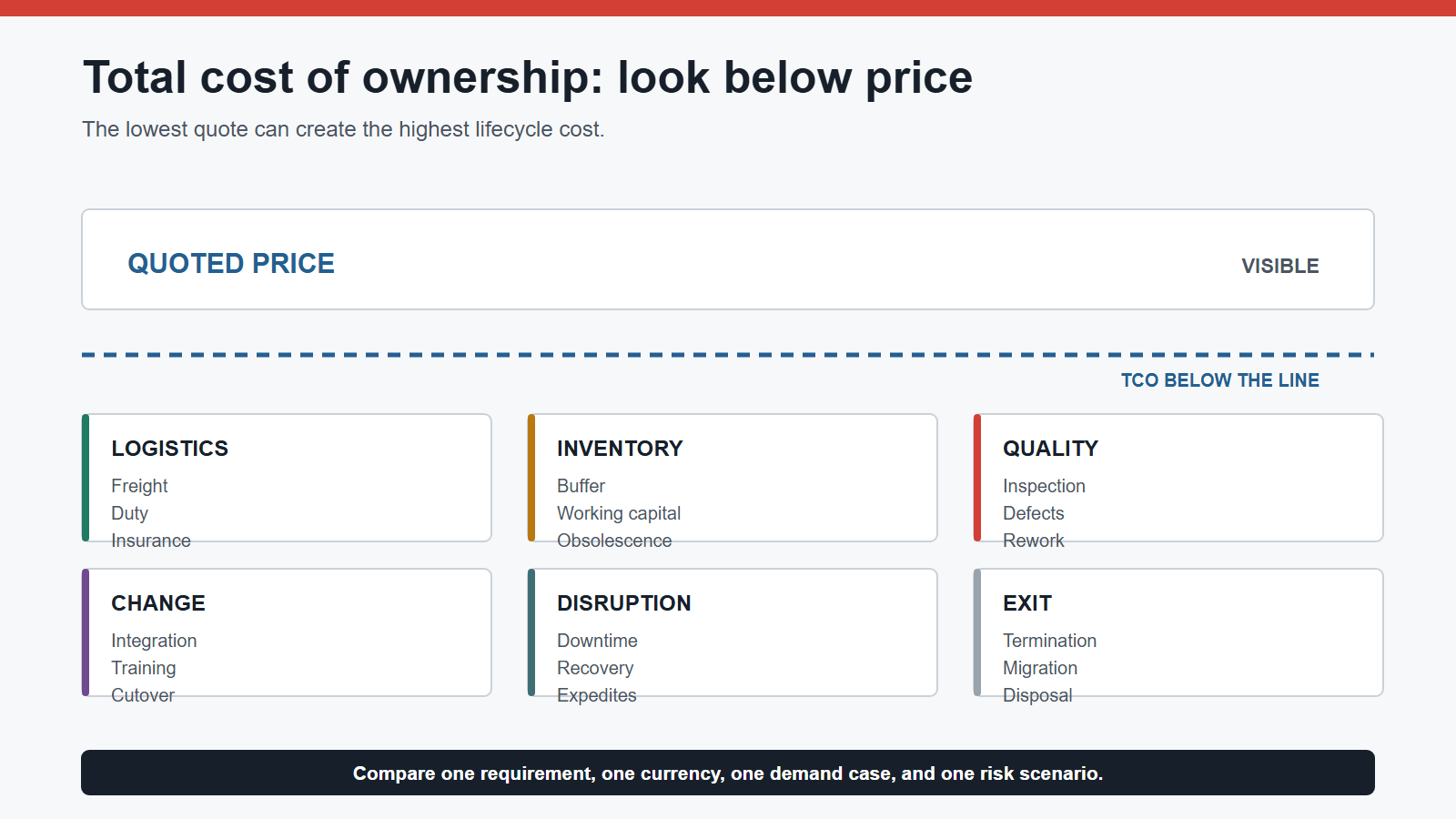
- Calculate TCO. Include logistics, quality, inventory, implementation, downtime, and exit costs.
- Choose an approach. Set the RFx type, lot structure, negotiation method, and award scenario.
- Write a fallback. Define the trigger and lead time for an alternate source.
Toolkit: Combine market-intelligence sources, customs data, commodity indices, should-cost models, and risk monitoring. The wider guide to sourcing products from China covers product-level execution. Use an RFI before an RFP when the market or requirement remains uncertain.
The data says: Deloitte found 74% of respondents viewed active alternative sources as an effective risk-mitigation strategy. Alternatives must be qualified, tooled, and contract-ready; a spreadsheet name is not a source.
2025 reality check: UNCTAD reported that Suez tonnage remained 70% below its 2023 average in early May 2025. A strategy tied to one corridor needs inventory, routing, or source alternatives before the next tender.
Step 4: Qualify and segment suppliers with the Kraljic Matrix
TL;DR: Qualify legal, operational, financial, compliance, and continuity evidence before scoring a proposal.
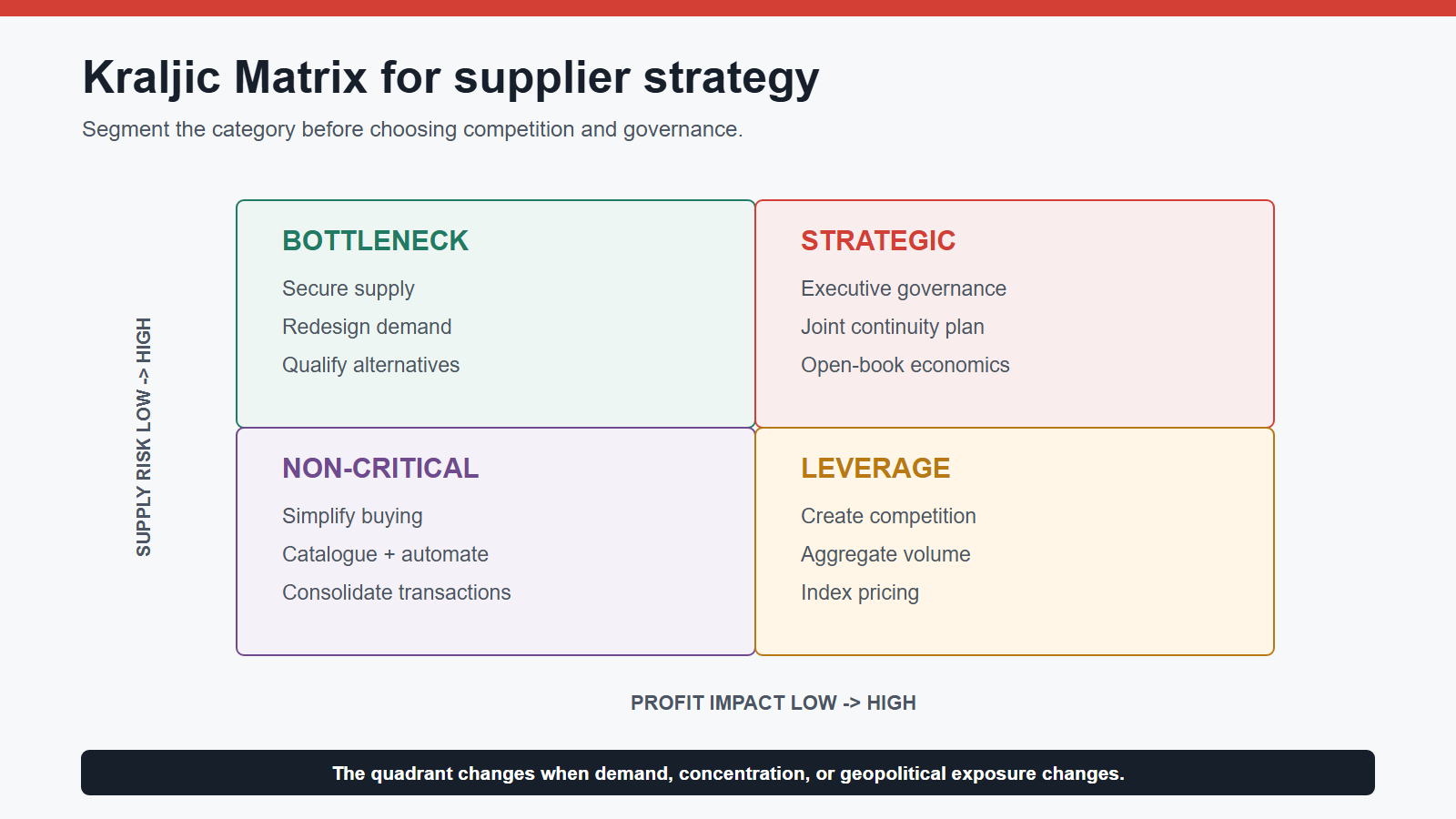
What and why: Prequalification stops an attractive bid from outrunning due diligence. The Kraljic Matrix then aligns effort with profit impact and supply risk.
How:
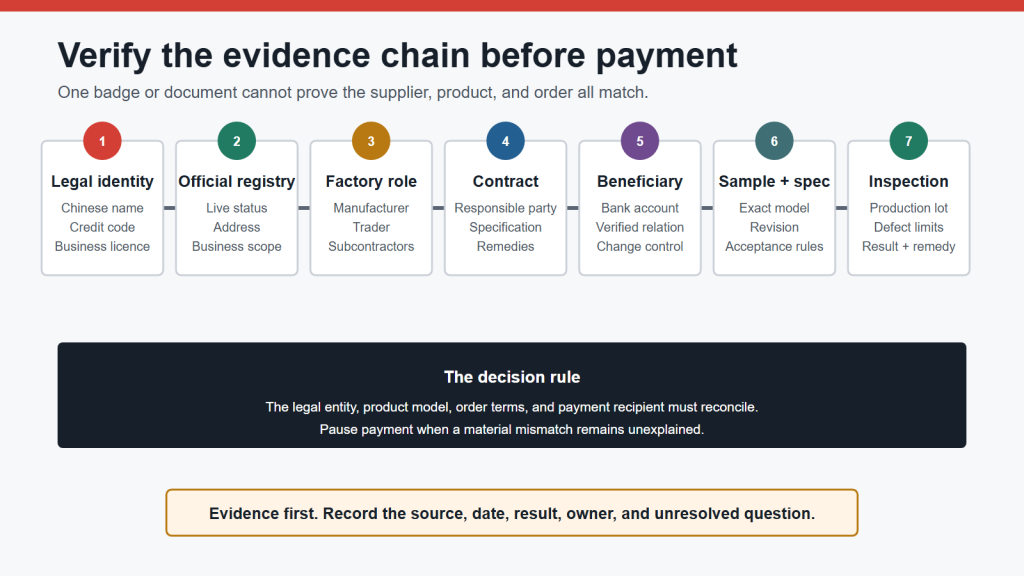
- Verify identity. Confirm legal name, ownership, licences, sanctions, and bank details.
- Test capability. Review capacity, quality controls, references, cyber controls, and continuity plans.
- Inspect evidence. Validate certificates, audit dates, product scope, and corrective actions.
- Plot the category. Place it in one Kraljic quadrant.
- Set the relationship. Match governance, contract length, competition, and contingency to the quadrant.
| Kraljic quadrant | Profit impact | Supply risk | Default treatment |
|---|---|---|---|
| Strategic | High | High | Executive governance, joint plans, open-book economics, tested continuity |
| Leverage | High | Low | Competitive tension, volume aggregation, indexed pricing |
| Bottleneck | Low | High | Secure supply, redesign demand, buffer stock, alternate qualification |
| Non-critical | Low | Low | Simplify, catalogue, automate, and consolidate transactions |
Toolkit: Supplier-information management, financial-risk tools, audit workflows, sanctions screening, and supplier verification procedures support an auditable gate.
The data says: Deloitte found 64% of respondents prioritized greater supply-chain visibility. Visibility starts with exact entities, manufacturing sites, sub-tier dependencies, and logistics nodes.
2025 reality check (scenario): A supplier’s office address does not reveal its port or sub-tier exposure. Site and lane mapping shows whether two “independent” bidders depend on the same constrained route.
Step 5: Run the RFx and compare total cost
TL;DR: Issue one controlled bid pack and normalize every response against the same assumptions.
What and why: RFIs discover capability, RFQs price defined requirements, and RFPs evaluate solutions. The evaluation model must exist before proposals arrive.
How:
- Choose the RFx. Match the document to requirement certainty.
- Publish rules. Give one timetable, question channel, currency, Incoterm, and response format.
- Score gates first. Reject mandatory failures before weighted scoring.
- Normalize bids. Correct units, volumes, exchange rates, exclusions, and escalation clauses.
- Model scenarios. Compare TCO under base demand and disruption cases.
Toolkit: E-sourcing suites can distribute events, seal bids, manage clarifications, and preserve an audit trail. The MadeInEast buyer path provides an additional route for qualifying Eastern manufacturers. Spreadsheet models remain useful when formulas, assumptions, and version control are explicit.
The data says: Deloitte found 67% of surveyed CPOs prioritized digital transformation and GenAI. A controlled e-sourcing event turns that investment into comparable bids instead of faster document production.
Compliance note: The GHG Protocol places purchased goods and services in Scope 3 Category 1. A complete scorecard can request cradle-to-gate emissions evidence alongside cost and quality when that impact is material.
2025 reality check (scenario): Freight surcharges can make quote dates and validity periods decisive. A normalized TCO model exposes suppliers that exclude rerouting, fuel, insurance, or inventory effects.
Step 6: Negotiate, contract, and award
TL;DR: Negotiate a complete operating agreement, not a headline discount.
What and why: Negotiation allocates value, obligations, and uncertainty. The award record must explain why the selected deal beats alternatives under approved criteria.
How:
- Set objectives. Define target, reservation point, alternatives, and tradeable terms.
- Trade conditionally. Exchange volume, term, forecast quality, or payment for measurable value.
- Close ambiguity. Resolve specifications, indexation, service credits, liability, data, ESG, and exit support.
- Run scenarios. Compare single, split, regional, and incumbent-plus-challenger awards.
- Document approval. Record scores, conflicts, deviations, and signatures.
Toolkit: Contract lifecycle management, clause libraries, e-signature, and approval workflows preserve negotiated intent. For protected platform orders, document how Trade Assurance protections connect payment, quality evidence, and remedies. Legal counsel should review jurisdiction-specific terms and regulated categories.
The data says: Deloitte reports 61% of respondents emphasized supplier information sharing and collaboration as effective risk mitigation. Contracts should specify the data, cadence, thresholds, and escalation path that make collaboration operational.
2025 reality check (scenario): “Force majeure applies” does not identify who will reroute, fund inventory, or notify customers. Specific triggers and recovery duties turn a generic clause into an executable plan.
Step 7: Implement, measure, and improve
TL;DR: Treat signature as the start of value delivery, with owners, milestones, controls, and re-sourcing triggers.
What and why: Savings leak when catalogues, POs, sites, users, and suppliers do not adopt the contract. Supplier performance management tests whether cost, quality, delivery, risk, and improvement reach operations.
How:
- Build the transition. Assign owners for data, inventory, tooling, testing, training, and cutover.
- Load controls. Update catalogues, prices, approval paths, and preferred-supplier rules.
- Baseline metrics. Record cost, OTIF, defects, lead-time variation, ESG, and risk events.
- Govern performance. Hold reviews at a cadence matched to the Kraljic quadrant.
- Trigger action. Define corrective action, development, contingency activation, and re-sourcing thresholds.
Toolkit: Supplier scorecards, ERP controls, quality systems, risk alerts, and QBR workflows close the loop. Use the pre-shipment inspection checklist when physical-goods quality must pass before final payment, then choose an independent inspection option proportionate to order risk.
The data says: Deloitte’s Digital Masters reported an average 3.2x return on GenAI investment, versus slightly above 1.5x among Followers. Process discipline and human capability distinguish useful automation from expensive output.
2025 reality check (scenario): A signed alternate-source contract offers no protection until specifications, tooling, master data, and trial orders work. Readiness evidence matters more than the supplier count on a slide.
How do you calculate the Sourcing Resilience Score?
TL;DR: SRS combines qualified supplier count and geographic diversity, then divides that strength by lead-time volatility to expose fragile categories.
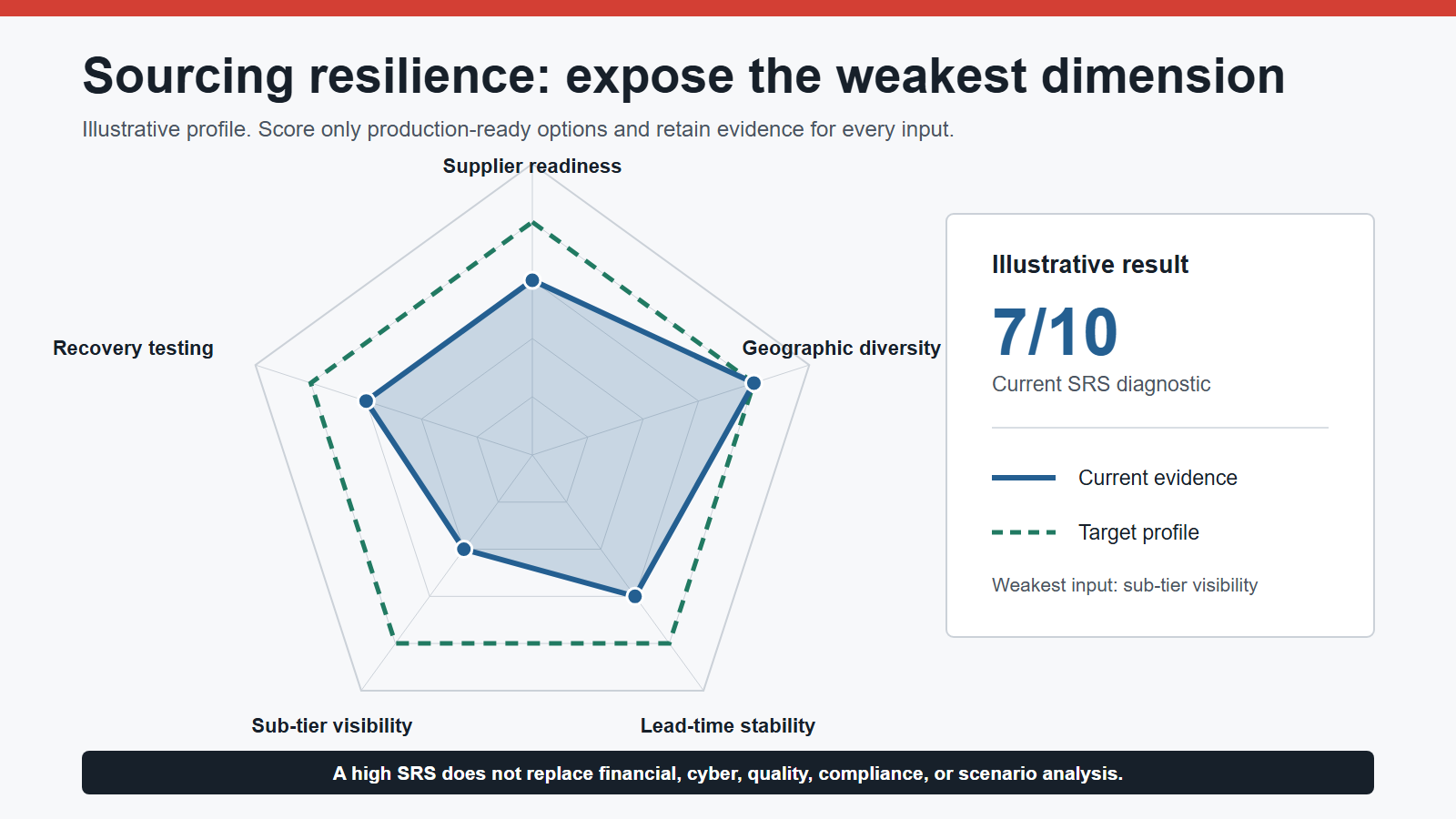
The Sourcing Resilience Score (SRS) is a MadeInEast management heuristic:
SRS raw score = (Qualified Supplier Count + Geo-Diversity Index) / Lead-Time Volatility Index
Use comparable 1–5 inputs. Cap qualified suppliers at five, then score geographic diversity from one to five.
Convert lead-time variation into a one-to-five volatility band. “Qualified” means production-ready, not merely identified.
| Input score | Qualified suppliers | Geo-diversity | Lead-time volatility |
|---|---|---|---|
| 1 | One | Same site or cluster | Very high; repeated material misses |
| 2 | Two, but one untested | One country | High |
| 3 | Two production-ready | Two countries, shared corridor | Moderate |
| 4 | Three production-ready | Multiple countries or corridors | Low |
| 5 | Four or more ready | Independent regions and corridors | Very low |
Convert the raw result to a 1–10 dashboard score with SRS = MIN(10, ROUND(raw score × 2, 0)).
Worked example: A category has three production-ready suppliers, a geo-diversity score of four, and volatility of two. Raw SRS equals (3 + 4) / 2 = 3.5; dashboard SRS equals 7/10.
| SRS | Interpretation | Management response |
|---|---|---|
| 1–3 | Fragile | Qualify an alternate, redesign demand, or hold a justified buffer |
| 4–6 | Exposed | Remove shared nodes and test recovery plans |
| 7–8 | Resilient | Maintain readiness and watch concentration drift |
| 9–10 | Strong on this diagnostic | Validate cyber, financial, quality, and sub-tier risks separately |
SRS is not a probability of disruption, industry benchmark, or substitute for scenario analysis. A category can score well yet fail because every supplier uses one sub-tier producer. Keep the input evidence beside the score and recalculate quarterly or after a material change.
How should procurement use agentic AI in sourcing?
TL;DR: Use agentic AI to assemble and test evidence, while named people retain authority over requirements, exclusions, negotiation, and award.
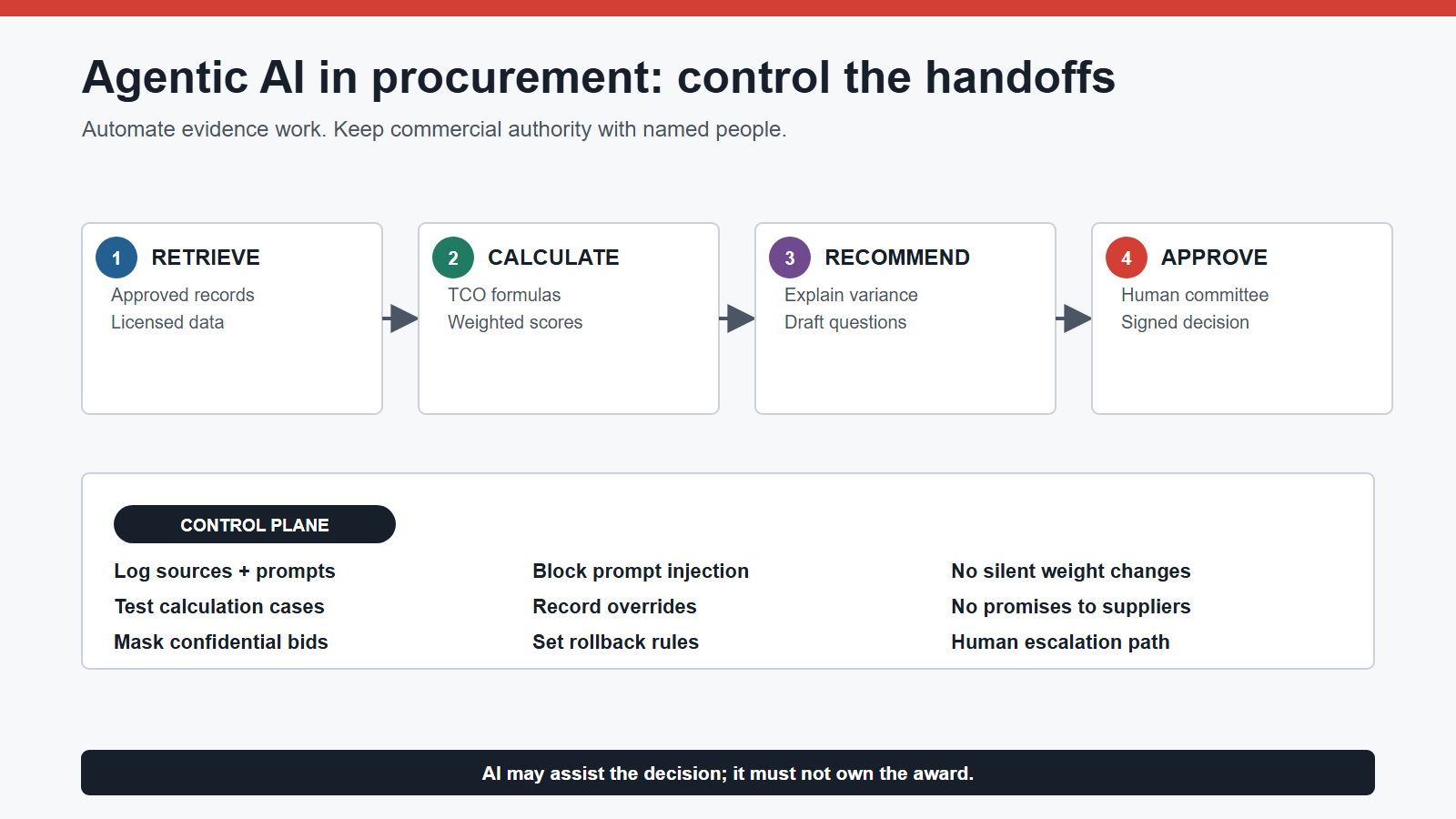
Agentic AI can plan and execute a bounded sequence instead of producing one response. In sourcing, an agent can classify spend, draft an RFI, extract proposal fields, flag missing evidence, normalize commercial terms, and prepare clarification questions. A second control can test totals, citations, and policy rules before a human sees the result.
The best design separates retrieval, calculation, recommendation, and approval. Retrieval agents may gather approved internal records and licensed market data.
Deterministic code should calculate TCO and weighted scores. A language model can explain variances. An accountable sourcing manager approves every supplier-facing message and award decision.
Do not let an agent silently change requirements or scoring weights after bids arrive. Log prompts, source records, tool actions, model versions, overrides, and final approvals.
Mask personal data and confidential bids by role. Test prompt injection from supplier documents, because a malicious instruction inside a PDF can target an automated evaluator.
Create a supplier-facing boundary, too. The agent may acknowledge receipt, detect incomplete fields, and route questions.
It should not promise volume, accept exceptions, reveal competing bids, or revise a deadline without approval. Give suppliers a human escalation path and preserve the exact message history.
Measure the pilot against a manual baseline. Track extraction accuracy, unsupported claims, calculation exceptions, analyst review time, supplier corrections, and award reversals. A fast summary that hides one exclusion is worse than a slower controlled comparison.
Deloitte’s 2025 survey provides a useful reality check. Digital Masters achieved an average 3.2x GenAI return, but respondents still named silos, competing priorities, capability, and talent as barriers. Technology magnifies the process and data it receives.
Three-step data hygiene checklist
- Standardize. Create controlled supplier, category, unit, currency, geography, and contract identifiers.
- Reconcile. Match spend to finance totals, quotes to source files, and model outputs to test cases.
- Govern. Assign data owners, access rules, freshness limits, exception queues, and audit retention.
Start with one low-risk event and a shadow evaluation. Compare the AI result with an experienced team, record every discrepancy, and set a rollback rule. Scale only after the control process catches known errors and produces repeatable evidence.
For MadeInEast platform-assisted sourcing, define where buyer support and supplier controls enter the workflow. Agent autonomy must never exceed the commercial authority granted to the person supervising it.
How do ESG, Scope 3, and geopolitics change supplier selection?
TL;DR: Supplier selection must test environmental, social, regulatory, and location evidence when those factors affect value, legality, or continuity.
ISO 20400:2017 gives organizations guidance for integrating sustainability into procurement and remains current after its 2023 confirmation. It is guidance, not a certifiable management-system standard. Ask suppliers for evidence proportionate to category impact instead of copying a universal questionnaire.
The GHG Protocol defines Scope 3 upstream emissions to include purchased goods and services. For material categories, request the calculation boundary, activity data, emission factors, base year, assurance status, and reduction plan. Do not award points for an unsupported net-zero logo.
Geopolitics changes logistics, tariff, sanctions, data, and continuity assumptions. Nearshoring favors proximity; friendshoring favors political and economic alignment.
Neither guarantees resilience. Test shared ports, energy sources, sub-tier suppliers, cyber dependencies, and switching lead time.
The European Commission states that Directive (EU) 2026/470 amended corporate sustainability reporting and due-diligence requirements in 2026. Applicability depends on company scope and national implementation, so legal counsel should confirm obligations. Procurement should still preserve traceable supplier evidence because customers and contracts may demand it beyond statutory scope.
Which procurement frameworks belong on a quick-reference sheet?
TL;DR: Use the 7 Rs, five governance pillars, 7 Cs, and 1PL–5PL as prompts, then apply category-specific evidence.
The 7 Rs of procurement
- Right quality
- Right quantity
- Right place
- Right time
- Right price
- Right source
- Right service
Five governance pillars
- Value for money
- Open competition
- Ethics and fair dealing
- Accountability and reporting
- Equity, where the governing policy requires it
The 7 Cs of supplier communication
- Clear
- Concise
- Concrete
- Correct
- Coherent
- Complete
- Courteous
Logistics layers: 1PL–5PL
- 1PL: The shipper runs logistics with its own assets.
- 2PL: An asset-based carrier provides transport or warehousing.
- 3PL: A provider operates outsourced logistics functions.
- 4PL: An integrator orchestrates multiple providers and the network.
- 5PL: A network orchestrator aggregates demand and capacity across providers.
Printable cheat sheet: Capture this section with the seven-step summary table and SRS scale. Add your policy owner, approval limits, mandatory gates, and escalation contacts before internal distribution. OECD descriptions support the 1PL–5PL distinctions; company policy must govern the other checklists.
Frequently asked questions about strategic sourcing
TL;DR: These answers cover the process questions procurement teams ask before launching, scoring, automating, and governing a sourcing event.
What is the first step in strategic sourcing?
A: Start by reconciling spend, contracts, demand, suppliers, and business ownership. The baseline shows whether the category is addressable and worth an event. Principle: TCO begins with complete demand and cost evidence.
How long does a strategic sourcing project take?
A: Duration depends on complexity, regulation, supplier qualification, testing, and stakeholder availability. Plan backward from contract expiry and include implementation, not only RFx dates. Principle: Risk management requires enough time to validate evidence.
What is the difference between an RFI, RFQ, and RFP?
A: An RFI explores market capability, an RFQ prices a stable specification, and an RFP compares proposed solutions. Choose the document after judging requirement certainty. Principle: TCO comparisons need equivalent assumptions.
How do you evaluate suppliers objectively?
A: Set mandatory gates and weighted criteria before bids arrive, then require evidence for every score. Normalize commercial assumptions and document overrides. Principle: Risk management separates qualification from preference.
What are the main benefits of strategic sourcing?
A: Strategic sourcing improves total value, supply continuity, decision traceability, contract adoption, and supplier performance. Savings matter, but price-only awards can increase lifecycle cost. Principle: TCO joins cost, quality, risk, and implementation.
When should procurement use the Kraljic Matrix?
A: Use it before choosing the market approach and governance model. Revisit the quadrant when demand, concentration, technology, or geopolitical exposure changes. Principle: Risk management matches effort to impact and supply risk.
Can AI choose the winning supplier?
A: AI can extract, normalize, test, and explain bid evidence. A named human committee should own requirements, exceptions, conflicts, negotiation, and award. Principle: Risk management requires accountability and appeal.
How often should suppliers be re-evaluated?
A: Match review frequency to category impact, risk, and change. Monitor critical thresholds continuously and conduct formal reviews at the contract cadence. Principle: Risk management treats qualification as perishable evidence.
How does Scope 3 affect procurement decisions?
A: Scope 3 includes upstream emissions from purchased goods and services. Material categories may need comparable supplier activity data, boundaries, factors, and reduction plans. Principle: ESG decisions require traceable evidence.
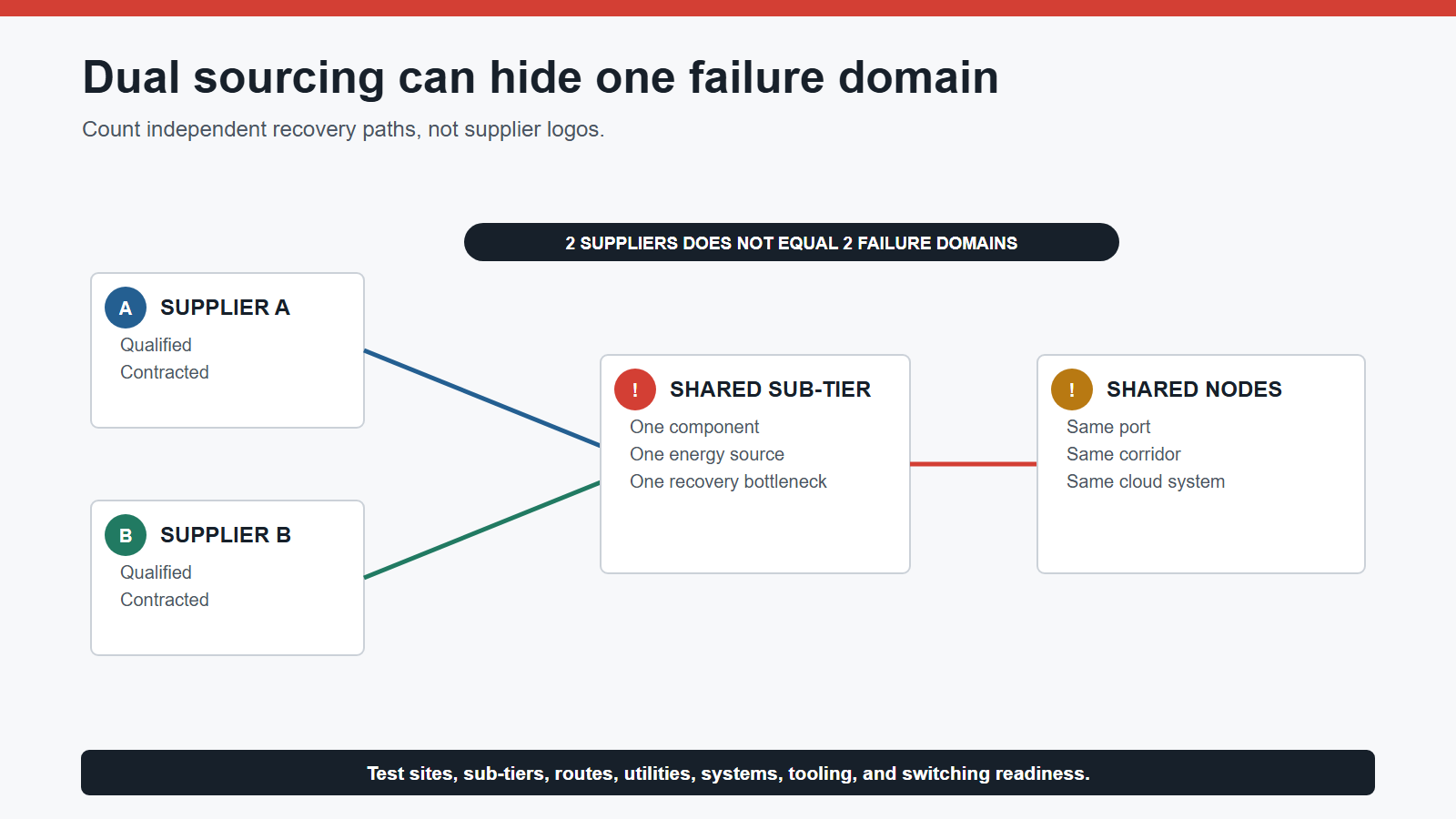
Is dual sourcing always more resilient?
A: No. Two suppliers may share one factory, sub-tier, port, energy source, or software dependency. Test independence and switching readiness before counting redundancy.
Principle: Risk management measures failure domains, not logos.
Put the next sourcing event under control
TL;DR: Start with one category, one reconciled baseline, one signed requirement set, and one evidence-backed scorecard.
Do not begin with a supplier search. Choose one category, reconcile its spend, sign its requirements, and calculate its SRS. Then run the seven gates with evidence owners and written stop rules.
Download the free supplier scorecard template. It includes weighted TCO, quality, continuity, compliance, cybersecurity, ESG, and implementation criteria.
Adapt each weight before bids arrive, never after seeing the prices. Review MadeInEast’s sourcing and protection model before mapping the template to a platform order.
Use the MadeInEast Help Center when a protected order needs an operational or dispute workflow.
Sources
TL;DR: Primary and authoritative sources support the article’s survey data, shipping evidence, standards, emissions rules, policy status, and logistics definitions.
- Deloitte, 2025 Global Chief Procurement Officer Survey
- Deloitte and Coupa, Future of Procurement
- UNCTAD, Review of Maritime Transport 2025 overview
- ISO 20400:2017, Sustainable procurement — Guidance
- GHG Protocol, Scope 3 frequently asked questions
- European Commission, corporate sustainability due diligence
- OECD, Enhancing the Performance of the Services Sector
- Gartner, Strategic Sourcing and Procurement