Pre-Shipment Inspection Checklist for China: The 42-Point Buyer’s Checklist
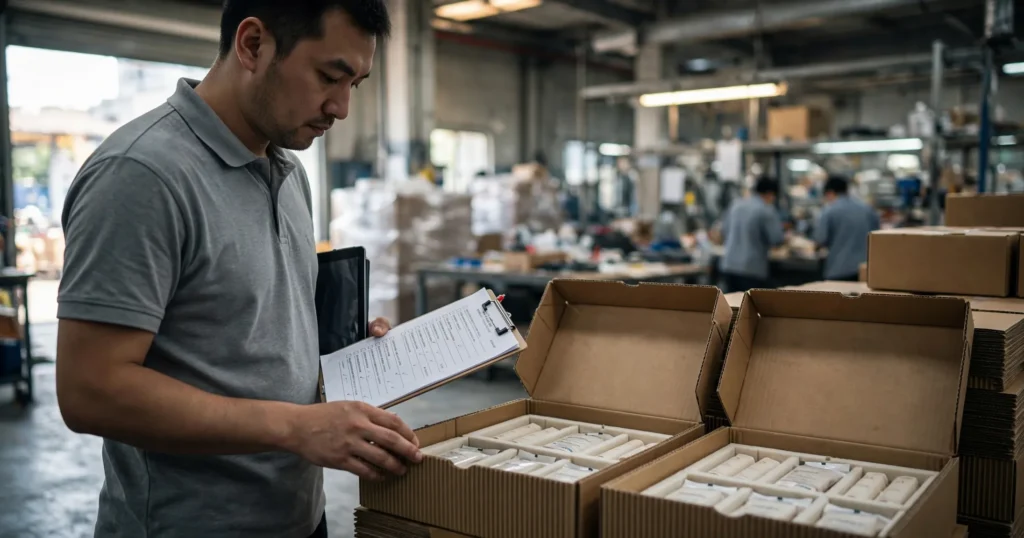
A pre-shipment inspection happens when your order is roughly 80% produced and packed. An inspector visits the factory, pulls a random sample from the finished cartons, and checks it against your specification — quantity, workmanship, function, labelling and packing. It is the last moment at which a defect is the supplier’s problem rather than yours.
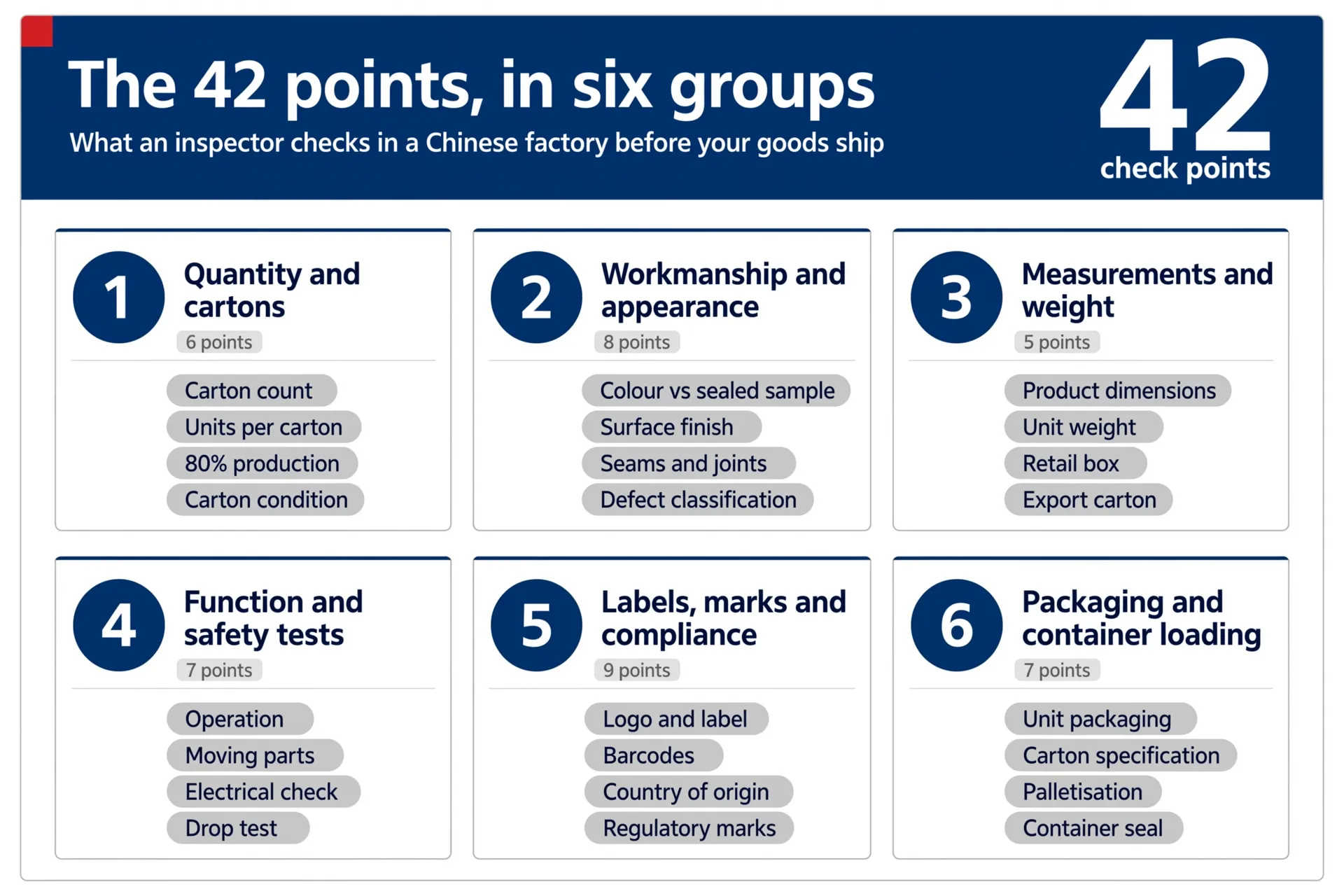
Below is the full 42-point checklist an inspector works through in a Chinese factory, with what a pass and a fail look like for each. Before that, the three things that decide whether the inspection is worth anything at all — and they are settled long before inspection day.
↓ Download the 42-point checklist as a PDF
Before the inspector arrives: three things to agree in the PO
Most inspection guides start on inspection day. That is too late. An inspection is only as good as the standard it measures against, and the standard is written into the purchase order.
1. Agree the AQL limits in the contract, not on the day.
AQL — Acceptable Quality Limit — is the pre-agreed number of defective units allowed in the sample before the batch is rejected. The commercial convention is 0 critical / 2.5 major / 4.0 minor. If those numbers are in the PO, a supplier who fails cannot argue about the threshold; the argument is over. If they are not, inspection day becomes a negotiation about what “acceptable” means, conducted while your container is waiting. This single line in a PO does more work than any other sentence in this article.
2. Seal an approved sample, and make sure both sides hold one.
The inspector compares production against a reference. With no signed, sealed, dated golden sample, “the colour is wrong” is an opinion. With one, it is a measurement. Photograph the sealed sample and keep the photo with the PO.
3. Decide in advance who pays for a re-inspection.
A failed batch usually means rework, and rework means a second inspector visit. That visit costs money. Suppliers who have agreed in writing to carry the cost of re-inspection after a failure tend to produce fewer failures — the clause changes behaviour before it is ever invoked.
If the supplier resists all three, that is information about the supplier, and it arrives cheaply.
When to book the inspection
At 80% production, packed and cartoned. This is the industry standard and the reasoning is specific: below 80% there is not enough finished stock to draw a representative sample, and the factory can present its best output. Much above it, and there is no schedule left to fix anything.
Give the inspection company several working days’ notice. Inspectors travel, factories are spread across provinces, and the good ones are booked. Late booking narrows your choice to whoever is free.
Once the container is sealed, you have no leverage. A pre-shipment inspection works because the supplier still holds goods they need you to accept. After loading, a defect discovered is a claim to argue, not a condition to fix. If your goods are at the port, an inspection is documentation, not protection.
The checklist — 42 points in six groups
Each point lists what the inspector actually does and what separates a pass from a fail. This is the part most checklists leave out: naming the item is easy, and the criterion is where the disputes happen.
Group 1 — Quantity and cartons (6 points)
| # | What the inspector does | Pass | Fail |
|---|---|---|---|
| 1 | Counts total cartons presented | Matches packing list exactly | Any shortfall, or cartons “still in another building” |
| 2 | Opens sample cartons, counts units inside | Units per carton match the declared count | Mixed quantities between cartons |
| 3 | Calculates total units against the PO | Matches the ordered quantity | Over- or under-shipment not agreed in writing |
| 4 | Confirms production is ≥80% complete and packed | Enough finished stock for a valid sample | Goods unpacked, unfinished, or partly at a second site |
| 5 | Checks carton condition | Clean, dry, undamaged, sealed | Crushed corners, water staining, resealed cartons |
| 6 | Verifies carton numbering and sequence | Sequential and complete | Gaps in numbering, duplicated numbers |
Group 2 — Workmanship and appearance (8 points)
| # | What the inspector does | Pass | Fail |
|---|---|---|---|
| 7 | Compares colour against the sealed sample | Within agreed tolerance in daylight | Visible shade variation across the batch |
| 8 | Inspects surface finish | No scratches, dents, blemishes above the minor threshold | Defects visible at arm’s length |
| 9 | Checks seams, joints, welds or stitching | Even, secure, correctly aligned | Loose stitching, gaps, weak joints |
| 10 | Examines edges and trims | Finished, deburred, no sharp edges | Rough or unfinished edges |
| 11 | Verifies print and artwork placement | Correct position, orientation, no smudging | Misaligned, mirrored or blurred print |
| 12 | Checks assembly and fit | Parts align, no forcing required | Gaps, misalignment, parts that do not seat |
| 13 | Confirms accessories and spare parts | Present in the agreed quantity | Missing screws, manuals, adaptors |
| 14 | Classifies every defect found as critical, major or minor | Counts stay within AQL limits | Any critical defect, or majors above the accept number |
Group 3 — Measurements and weight (5 points)
| # | What the inspector does | Pass | Fail |
|---|---|---|---|
| 15 | Measures product dimensions against the spec | Within stated tolerance | Outside tolerance on any critical dimension |
| 16 | Weighs the product | Matches the declared unit weight | Variance suggesting a material substitution |
| 17 | Measures the retail box | Matches the packaging spec | Will not fit agreed shelf or shipper dimensions |
| 18 | Measures and weighs the export carton | Matches the supplier’s detail sheet | Cartons heavier or larger than declared |
| 19 | Compares measured weights with the shipping marks | Marks match reality | Marks copied from an old spec — a freight and customs problem later |
Group 4 — Function and safety tests (7 points)
| # | What the inspector does | Pass | Fail |
|---|---|---|---|
| 20 | Operates the product as a customer would | Functions as specified | Any failure to operate |
| 21 | Tests moving parts through full travel | Smooth, complete movement | Sticking, grinding, incomplete travel |
| 22 | Powers on electrical items and runs a basic function check | Powers up and performs | Dead units, intermittent operation |
| 23 | Checks plug type and voltage rating | Correct for the destination market | Wrong plug or rating — a market-entry blocker |
| 24 | Tests closures: zips, buttons, clasps, hinges | Operate repeatedly without failure | Failure within the agreed cycle count |
| 25 | Applies load or stress tests where specified | Holds the rated load | Deformation or failure below rating |
| 26 | Performs a carton drop test | Contents undamaged after the drop | Product damage — packaging will not survive transit |
Group 5 — Labels, marks and compliance (9 points)
| # | What the inspector does | Pass | Fail |
|---|---|---|---|
| 27 | Checks the brand logo | Correct artwork, size and placement | Distorted, outdated or wrong-colour logo |
| 28 | Verifies the product label | Matches the approved artwork | Wrong version, typos, wrong language |
| 29 | Checks care, material or composition labels | Present, correct, correctly attached | Missing or contradicting the spec |
| 30 | Scans every barcode type on the product and carton | All scan and return the right code | Any barcode that will not scan — a retail rejection |
| 31 | Verifies country-of-origin marking | Present and correct for the destination | Missing — a customs problem, not a quality one |
| 32 | Checks regulatory marks (CE, UKCA, FCC, EAC and equivalents) | Present where required | Missing, or applied without documentation |
| 33 | Checks hangtags and swing tickets | Correct, attached, priced if required | Missing or wrong market’s tags |
| 34 | Confirms warning and instruction text | In the destination market’s language | English-only where local language is mandatory |
| 35 | Verifies shipping marks on the export carton | Match the buyer’s requirement | Wrong consignee, port or reference |
Group 6 — Packaging and container loading (7 points)
| # | What the inspector does | Pass | Fail |
|---|---|---|---|
| 36 | Checks unit packaging | Correct material and construction | Substituted or thinner material |
| 37 | Checks inner packing and protection | Adequate for transit | Insufficient padding, loose items |
| 38 | Verifies the export carton specification | Correct ply, size and strength | Downgraded board |
| 39 | Checks palletisation | Stacked, wrapped and strapped as specified | Unstable stacks, wrong pallet type |
| 40 | Inspects the container before loading | Clean, dry, no holes, no odour | Damage or contamination |
| 41 | Supervises the loading sequence and count | Full agreed quantity loaded, secured | Miscount, poor stowage, crushing risk |
| 42 | Records the container seal number and photographs it | Seal number documented and matches paperwork | Seal missing, or number not recorded |
↓ Download all 42 points as a printable PDF
AQL, and how the accept and reject numbers are calculated
Almost every inspection page says “we inspect to AQL standards” and stops. Here is the arithmetic.
Step 1 — the sample size comes from the lot size. Not from a percentage. Under ISO 2859-1 (identical in practice to ANSI/ASQ Z1.4), General Inspection Level II, an order of 3,201–10,000 units draws a sample of 200. A 5,000-unit order and a 9,000-unit order are sampled identically.
Step 2 — defects are sorted into three classes. Critical (unsafe or illegal), major (the customer would return it), minor (noticeable but acceptable).
Step 3 — each class carries its own accept and reject number. Worked through:
Order: 5,000 units · Sample: 200 · Limits: 0 / 2.5 / 4.0
Class Accept if ≤ Reject if ≥ Critical 0 1 Major 10 11 Minor 14 15 Nine major defects in the sample: pass. Eleven: fail — and the entire 5,000-unit batch is rejected, not the eleven units.
Two consequences worth internalising. Tightening the AQL costs money — a lower limit means more rejections and more rework, and suppliers price that in, so demand 1.0 only where it matters. And a pass is a statistical statement, not a guarantee: it means the batch’s defect rate is probably below your threshold. Anyone selling certainty is selling something that does not exist.
Documentation the inspector should check
Physical quality is only half of what stops a shipment. Ask for these to be verified on site:
- Commercial invoice and packing list reconciled against the physical count — the most common source of customs delays is paperwork that disagrees with the container.
- Certificates of conformance and test reports for any regulated component, present and matching the batch.
- Country-of-origin documentation, consistent with the marking on the goods.
- Export licences or permits where the product category requires them.
A perfect product with contradictory paperwork still sits at the border.
What the report contains, and what a PSI certificate is for
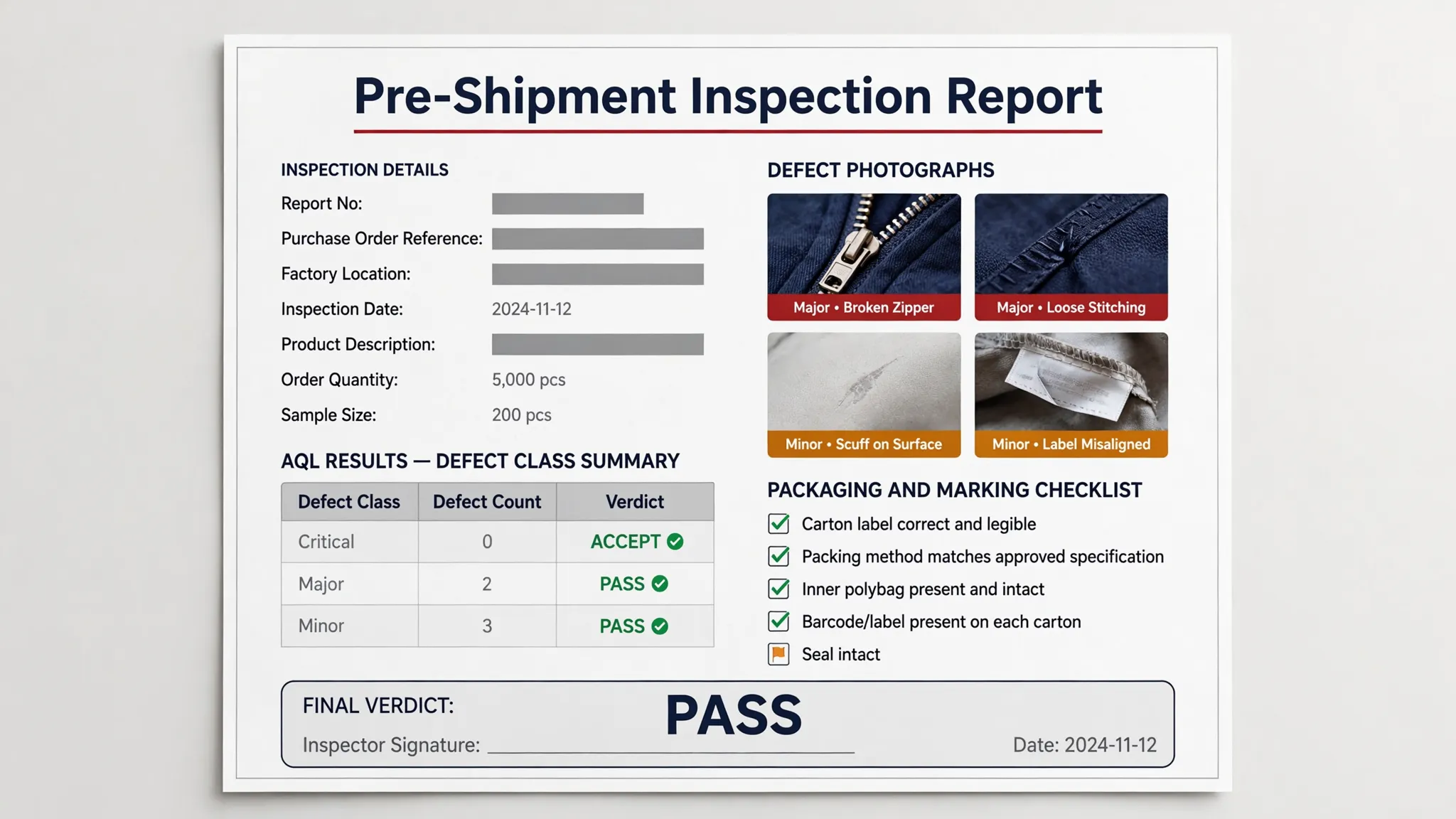
A usable inspection report contains the quantity verification, the AQL result with the accept/reject numbers applied, photographs of every defect grouped by severity, the packaging and marking checks, and one plain verdict: pass, fail, or pass with conditions.
A pre-shipment inspection certificate is the formal statement that the goods conform to the agreed standard. It matters in three places: customs clearance in markets that require one, releasing payment under a letter of credit, and supporting an insurance or dispute claim later.
The report’s real audience is often your supplier. A photographed defect with an AQL reference starts a conversation about rework. An email complaint starts a conversation about opinions.
What happens if the inspection fails
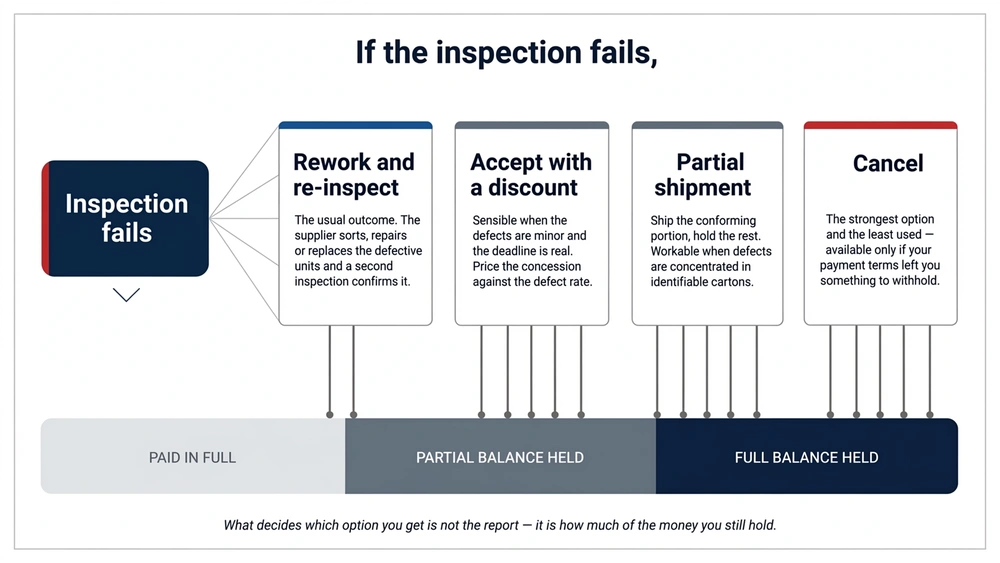
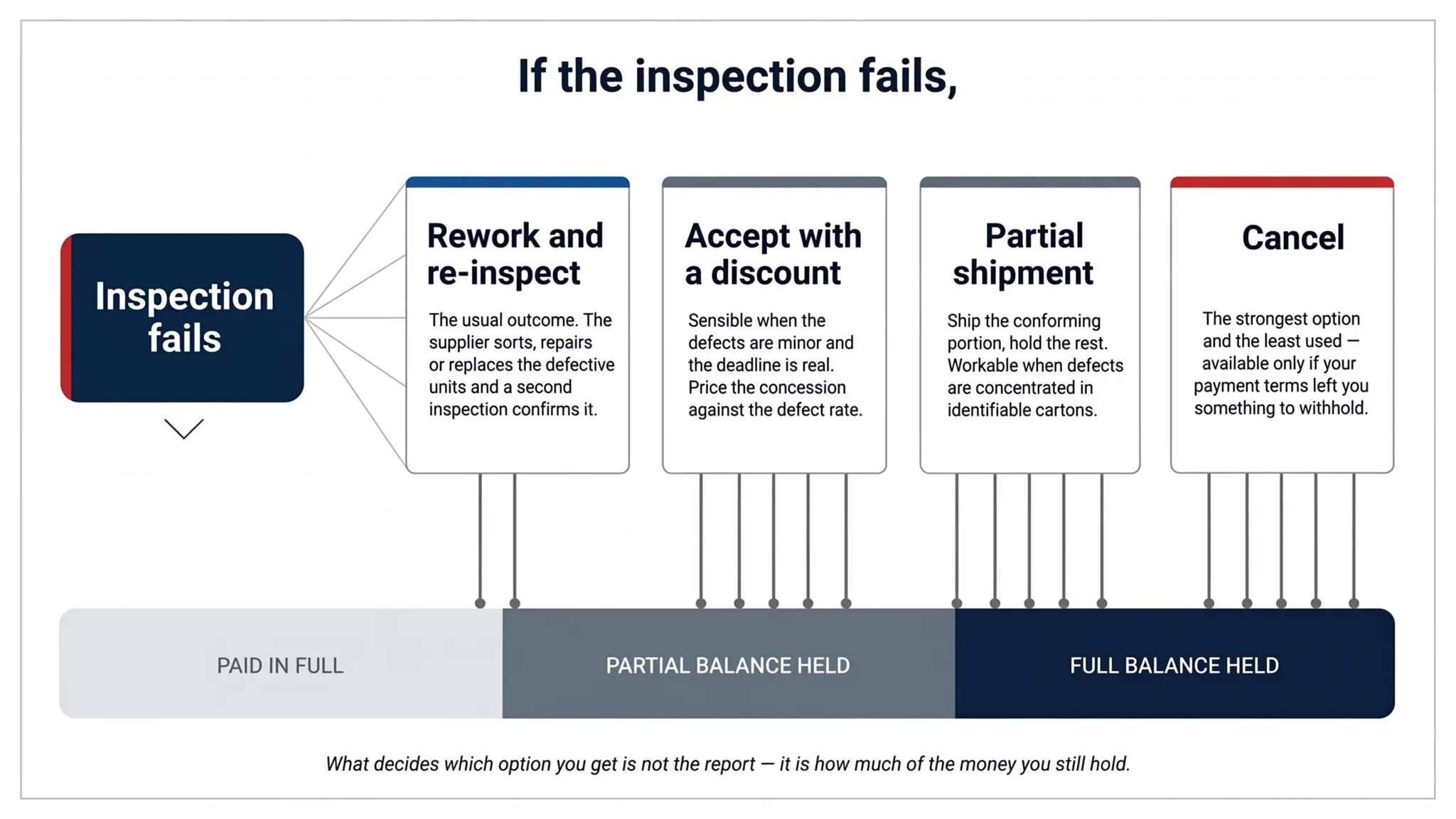
A fail is not a disaster; it is the system working. You have four options, and the report is your leverage in all of them.
- Rework and re-inspect. The usual outcome. The supplier sorts, repairs or replaces the defective units and a second inspection confirms it. This is where the PO clause on who pays for the second visit earns its place.
- Accept with a discount. Sensible when the defects are minor and the deadline is real. Price the concession against the defect rate in the report, not against a feeling.
- Partial shipment. Ship the conforming portion, hold the rest. Workable when the defects are concentrated in identifiable cartons.
- Cancel. The strongest option and the least used, because it is only available if your payment terms left you something to withhold.
What decides which option you get is not the report — it is how much of the money you still hold. An inspection scheduled before final payment is protection. One scheduled after it is a receipt.
Book a pre-shipment inspection in China →
When a pre-shipment inspection is not worth booking
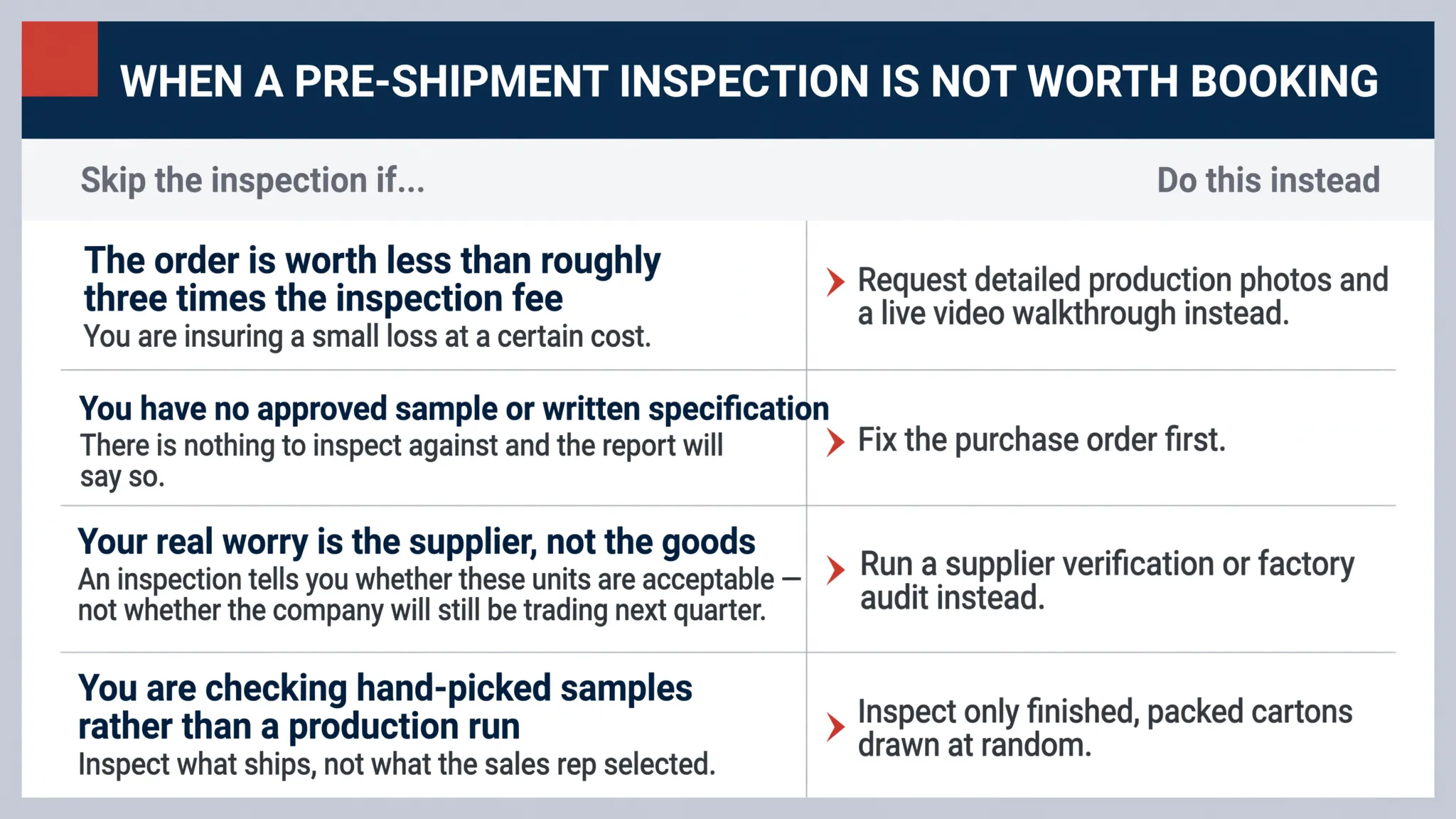
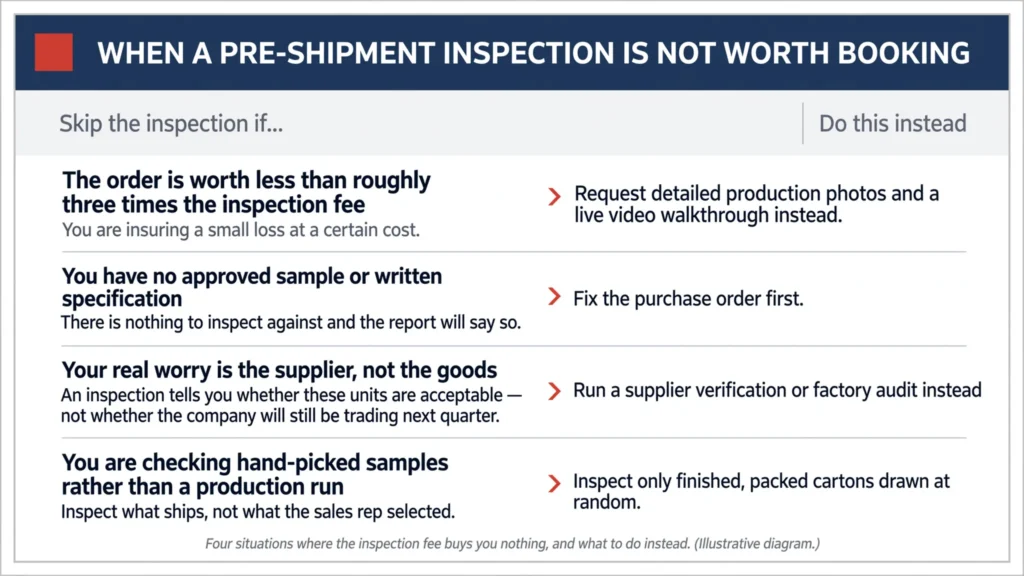
- The order is worth less than roughly three times the inspection fee. You are insuring a small loss at a certain cost. Ask for detailed production photos and a live video walkthrough instead.
- You have no approved sample or written specification. There is nothing to inspect against and the report will say so. Fix the PO first.
- Your real worry is the supplier, not the goods. An inspection tells you whether these units are acceptable. It does not tell you whether the company owns the factory it claims to, or will still be trading next quarter. That is a different job: how to verify a Chinese supplier.
- You are checking hand-picked samples rather than a production run. Inspect what ships, not what the sales rep selected.
Doing it yourself versus booking an inspector
Visiting the factory yourself is worth doing at least once — you learn more in an afternoon on a production floor than in a year of emails. But it is not a substitute for inspection, for two reasons.
The factory’s own QC report is not third-party evidence. It may be entirely honest and it still carries no weight in a dispute, because the party producing it is the party being assessed. And a scheduled visit is an announced one: you will be shown a good line on a good day.
Independence is the product. You are not buying someone to look at boxes; you are buying a record made by a party with no stake in the answer. Who performs the inspection, and to what standard, is worth asking before you book — ours is on our about page.
Frequently asked questions
How much does a pre-shipment inspection in China cost?
Third-party inspection is quoted per inspector-day, so the cost tracks how long the job takes rather than your order value. A large order of one simple product is cheap to inspect; a small order of a dozen complex SKUs across several factories is not. Factory location adds travel time. Our current rates are on the inspection service page.
How long does an inspection take?
Typically one inspector-day on site for a standard consumer-goods order, with the report following shortly after. Complex products, multiple SKUs or several factories extend it.
Can the supplier be present?
Yes, and they almost always are — the factory provides the goods and the space. What they cannot do is choose the sample. The inspector draws it at random from finished, packed cartons.
What is the difference between a pre-shipment inspection and a factory audit?
An inspection checks the product before it ships. An audit checks the supplier before you order — capacity, equipment, quality systems, compliance. Different stage, different decision. Most importers need the audit once and the inspection every order.
Can I rely on the factory’s own quality control?
As a first line, yes. As evidence, no. A supplier’s QC report is produced by the party being assessed.
Is one final inspection enough?
For repeat orders with a proven supplier, usually. For a first order, a new product, or a tight deadline, a during-production inspection at 30–50% completion catches systemic faults while there is still time to correct them — after final inspection, the only remedy is rework.
Does an inspection guarantee compliance in my market?
No. Inspectors verify what is visible and testable on site. Regulatory compliance — chemical limits, electrical safety certification, restricted substances — requires laboratory testing, which is a separate service.
What is a pre-shipment inspection certificate?
A formal document confirming the goods met the agreed standard. Some markets require one for customs clearance; it is also used to release payment under a letter of credit and to support later claims.
Related
- How to verify a Chinese supplier: the 10-point checklist
- Sourcing agent vs sourcing company: which do you need?
- (add once live: the pillar — “the full guide to sourcing from China”; and “audit the factory before you order” →
/factory-audit-checklist/)